
Street Art 167 Nardò
Franco Arminio and the Peripheries
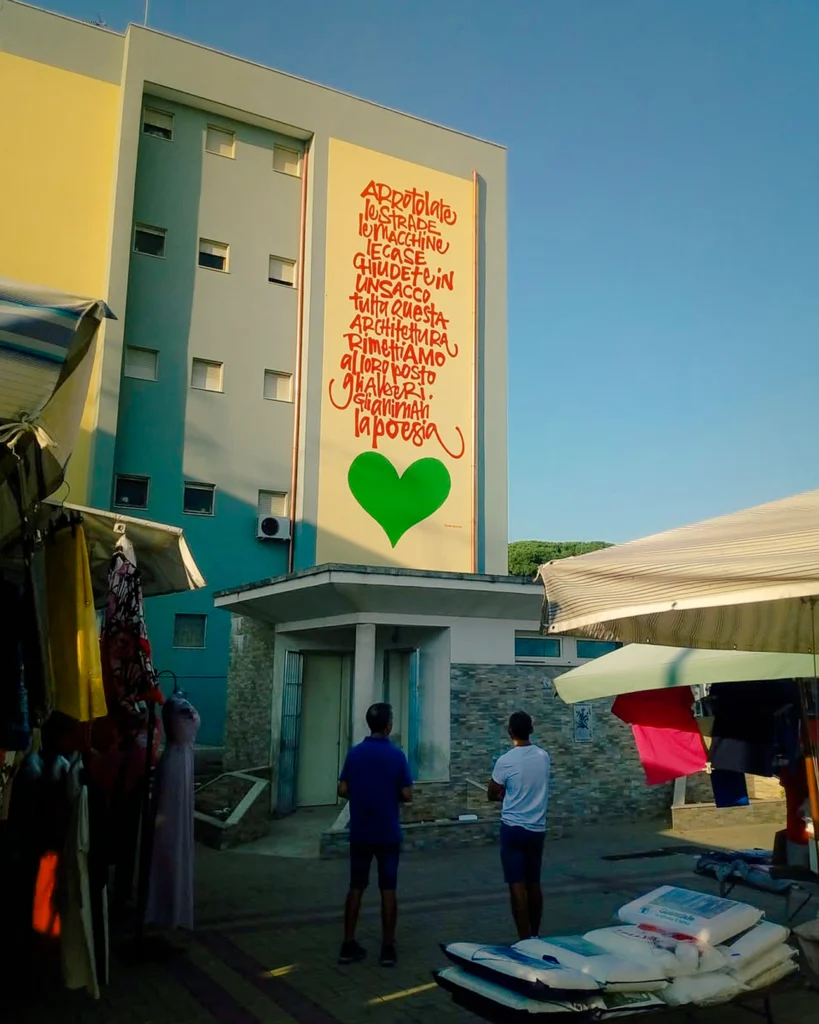
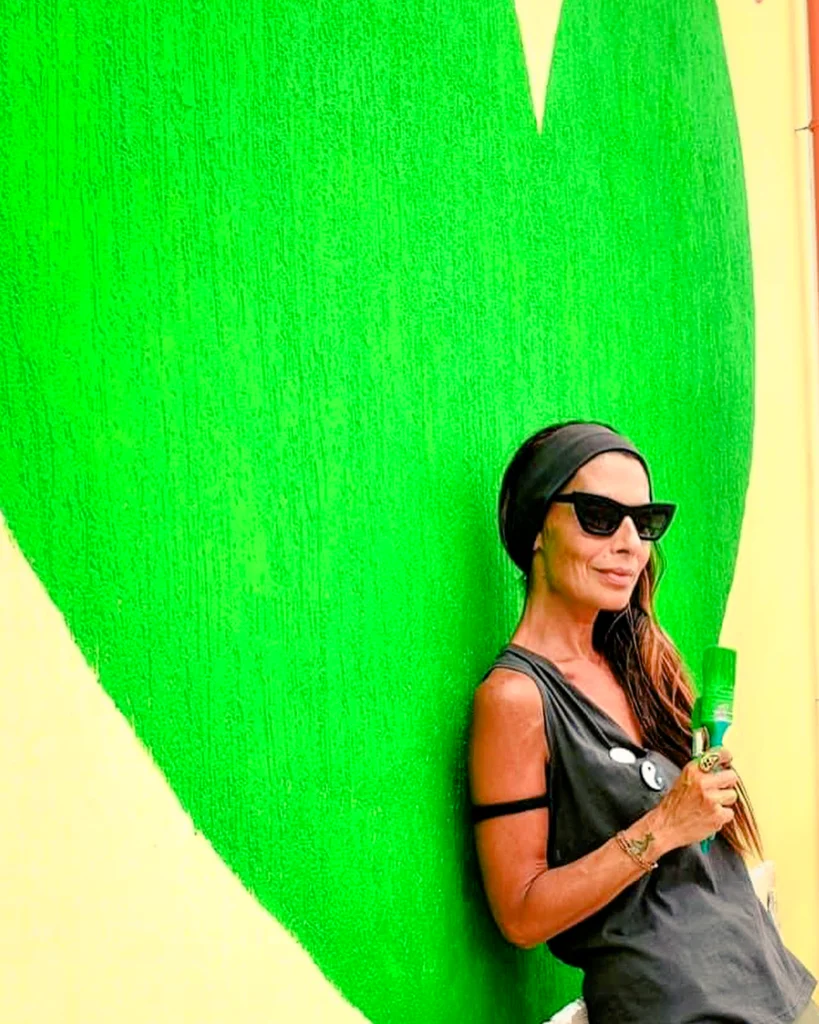
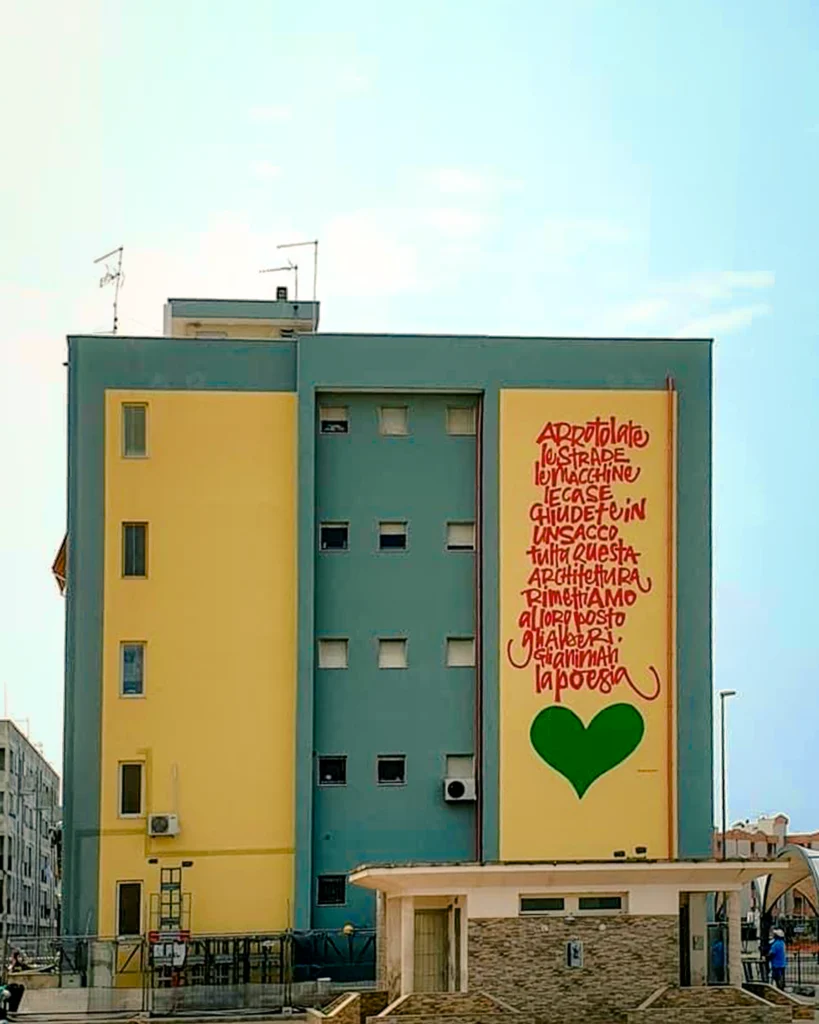
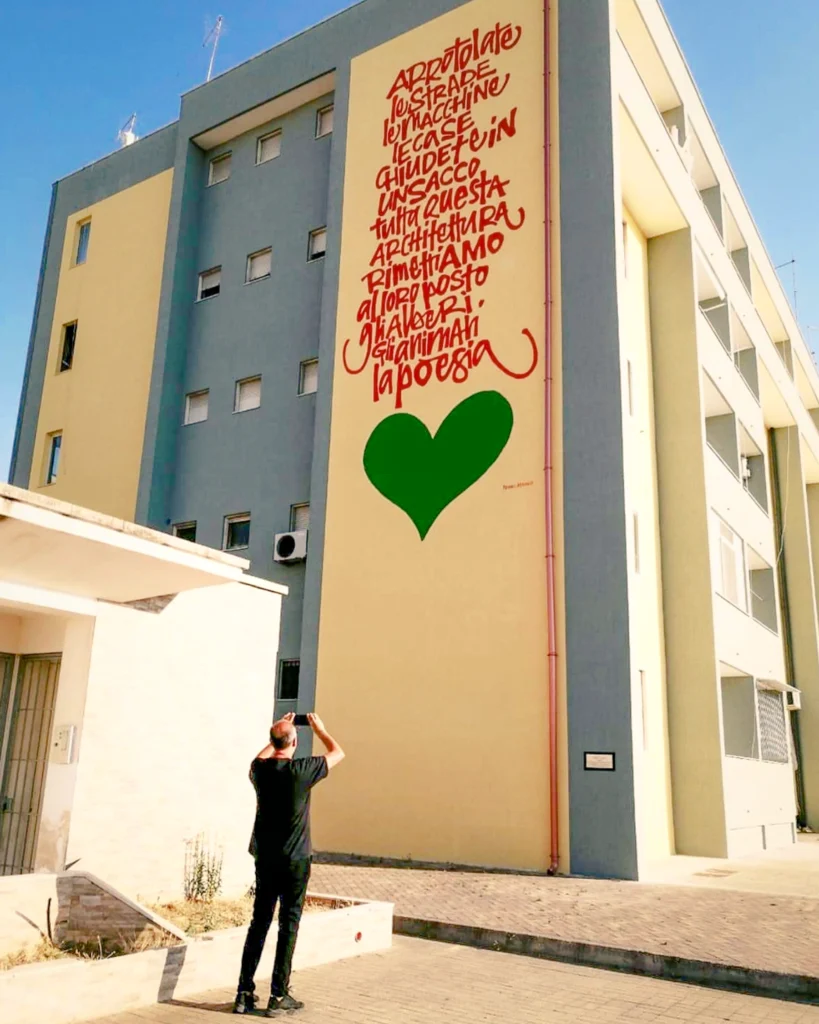
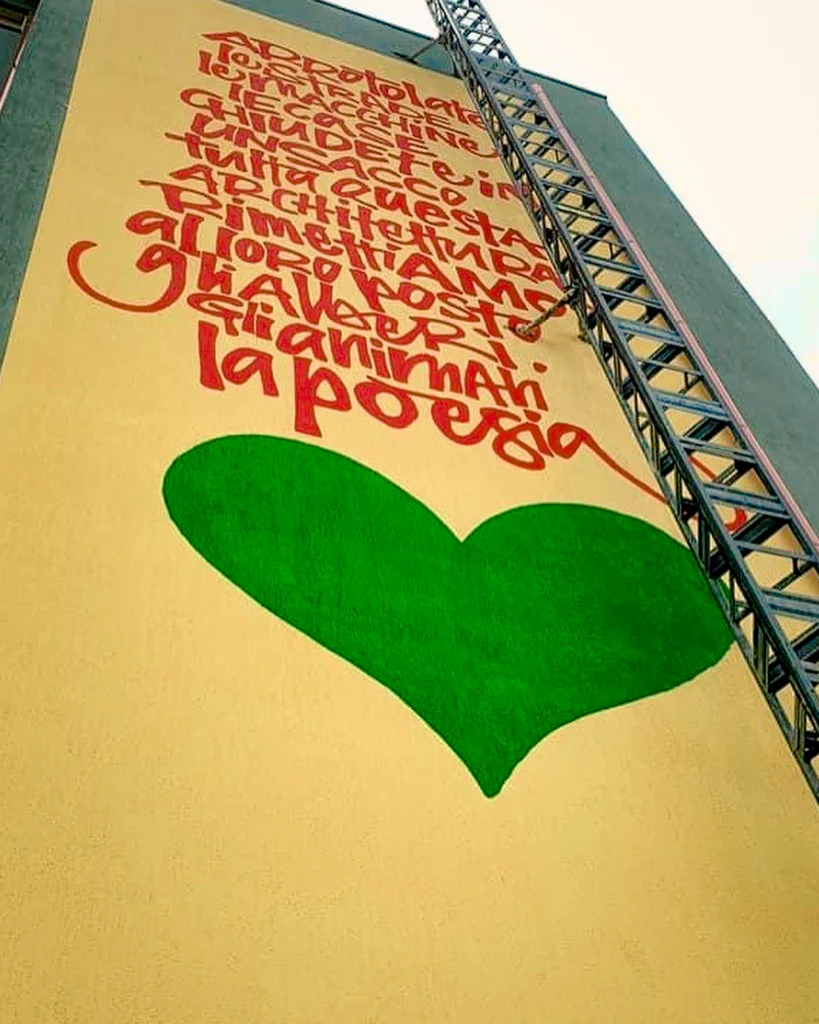
Marta Lagna’s street art intervention in Nardò features a quotation from a text by Franco Arminio, taken from Terracarne:
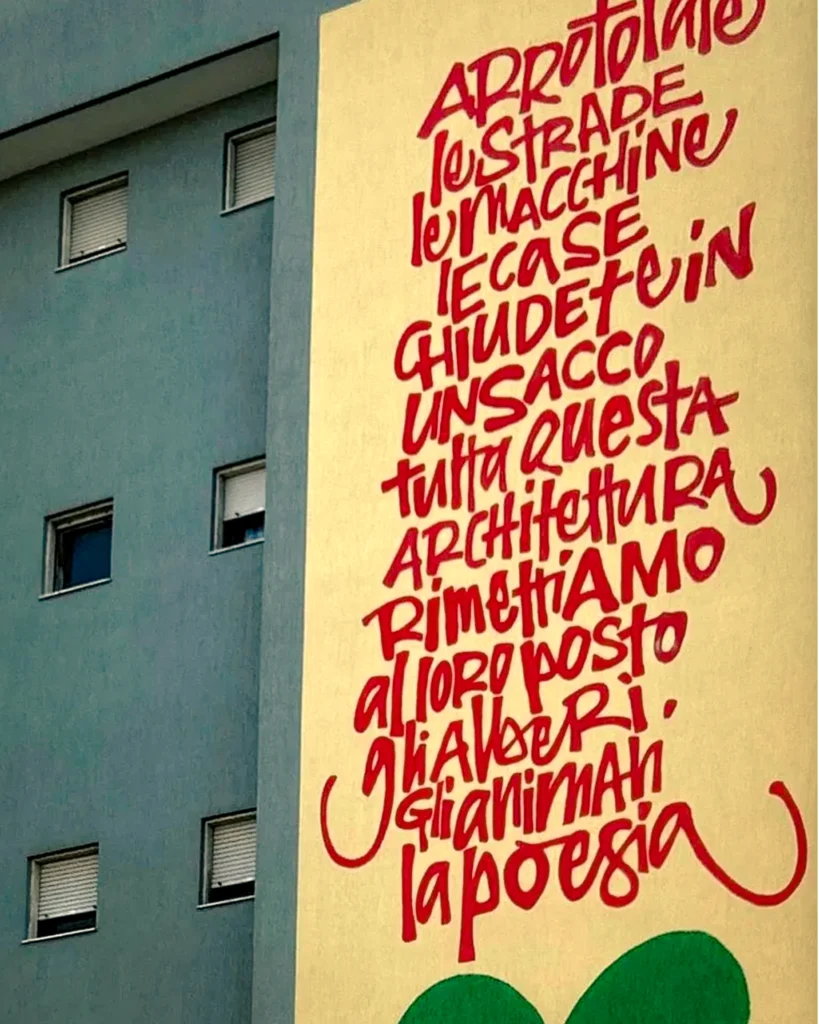
“Arrotolate le strade, le macchine, le case.
Chiudete in un sacco tutta questa architettura.
Rimettiamo al loro posto gli alberi, gli animali, la poesia.”
Bringing these words by Franco Arminio onto the wall of a peripheral neighbourhood means doing more than transforming a wall into a work of art.
It means bringing poetry into the city precisely where the city reveals its contradictions most clearly.
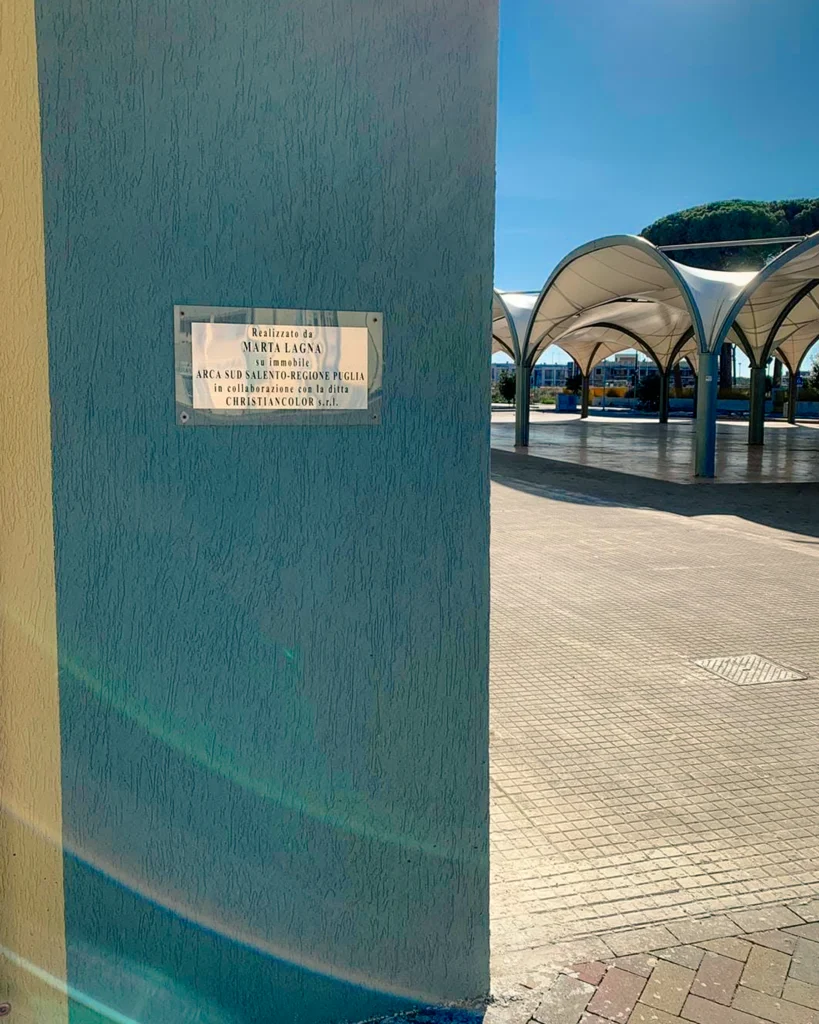
This is the meaning of the intervention created by Marta Lagna in September 2019 in Nardò’s 167 district, on Via della Costituzione, in the area of Piazza 1° Maggio. A large-scale urban calligraphy project built around a text from Terracarne, Arminio’s book in which the Italian territory is observed through towns, peripheral areas, marginal landscapes and communities.
Here, the choice of text and the choice of location are inseparable.
The poem speaks of streets, cars, houses and architecture that have progressively occupied the landscape. The wall stands precisely within that built environment.
There is therefore no need to add another image to the periphery. What is needed is to ask it a question.
When Poetry Enters the 167 District
The 167 district is one of those urban spaces in which the contemporary city appears in its most concrete form: residential buildings, roads, collective spaces, services and areas of passage.
It is not a historic centre represented through memory. Nor is it a cultural space designed to accommodate an artwork.
It is a place of everyday life. And this is precisely where Marta Lagna chooses to bring writing.
Arminio’s words are not isolated from their surroundings. On the contrary, they enter into friction with them.
“Put all this architecture into a sack.”
Read on a wall in the 167 district, the sentence acquires a different weight. It is no longer simply a poetic image. It becomes almost an impossible instruction, a provocation addressed directly to the space surrounding it.
And then comes the reversal:
“Let’s put the trees, the animals, the poetry back in their place.”
The mural thus becomes a reflection on the city starting from the city itself.
Marta Lagna: Writing Instead of Representing
One of the defining aspects of the intervention is the decision not to translate the text into a figurative image.
Marta Lagna does not represent trees, animals or architecture.
She writes.
It is a radical choice because it gives the word full responsibility for the image.
Calligraphy takes on an urban scale and ceases to be a practice associated exclusively with paper, manuscripts or precious objects. The movement of the hand is enlarged until it confronts architecture.
Letters, rhythm, pressure and the movement of the line become compositional elements.
The text is not simply applied to a surface: it transforms that surface into a visual experience.
This is where Marta Lagna’s research meets street art.
Not through the language of urban decoration, but through the possibility of using writing to alter the perception of a place.
Franco Arminio and Landscape as a Political Question
Franco Arminio describes his work through paesologia: an approach to territory that begins with observing places, especially those far from major urban centres, and the people who inhabit them.
In Terracarne, landscape is not a postcard.
It is an organism shaped by transformations, abandonment, construction, memories and conflicts.
The sentence chosen for Nardò condenses this attention.
Streets, cars and houses represent a particular idea of development: one in which territory is progressively organised, occupied and built upon.
Trees, animals and poetry instead introduce what risks being excluded from this logic.
Bringing the text into a peripheral neighbourhood therefore transforms a reflection on landscape into a reflection on the contemporary city.
Not a celebration of the periphery, but a critical look at what the periphery reveals.
The Wall as a Space of Dissent
A mural can decorate, celebrate or commemorate. It can also challenge the way we look at a place.
This is what makes this work particularly compelling.
Arminio’s words are deliberately unsettling. They invite us to question what we normally accept as part of the urban landscape: streets, cars, buildings and infrastructure. Rather than offering another representation of the city, they ask what may have been lost in the process of constructing it.
Calligraphy gives this reflection a public form without turning it into an explicit political statement. The gesture remains poetic, while its meaning engages directly with the realities of contemporary urban life.
On the wall of the 167 district, poetry becomes a way for the built environment to question itself.
Writing as Architecture
One of the most compelling aspects of Marta Lagna’s work is the relationship between writing and space.
When calligraphy moves from the page onto an architectural surface, its scale, physical presence and perception all change.
It is no longer read only with the eyes.
It is experienced.
Distance changes the way the work is read. From afar, the entire composition can be perceived as a graphic mass, while up close letters, words, details and variations in the gesture emerge.
Writing therefore acquires a dual nature: it remains language while simultaneously becoming visual matter.
In the 167 project, this ambiguity is essential.
The poetry is read, but before that, it is seen.
A Periphery That Finds Its Voice
Bringing a literary text into a peripheral neighbourhood also challenges our conventional idea of where culture belongs.
A museum, a gallery or a historic centre usually defines the context in which an artwork is encountered. Here, the setting is completely different: a wall in Nardò’s 167 district, in an area crossed every day by residents, workers and passers-by.
The work does not ask for a dedicated audience. It enters the rhythm of everyday life, becoming part of a familiar route rather than an isolated cultural destination.
There is no threshold to cross, no ticket to buy and no need to know who created it. The encounter happens naturally, sometimes almost accidentally.
This is what makes the intervention significant: poetry leaves the protected context of the literary page and becomes part of the public landscape, available to anyone who happens to pass by.
From Landscape to Responsibility
The Nardò project remains relevant because the question contained in Arminio’s verses does not belong only to 2019.
How much space do we leave for nature within increasingly built-up cities?
How much of a place’s identity survives when architecture and infrastructure radically transform its landscape?
And above all: can art intervene without simply making a space more beautiful?
Marta Lagna’s mural answers through writing. It does not add another image to the city.
It adds a voice.
A voice that comes from poetry and, through calligraphy, finds a public dimension.
A Poem That Refuses to Stay in Its Place
There is one final paradox at the heart of the project.
Arminio asks us to “put back in their place” poetry, trees and animals.
Marta Lagna does exactly the opposite: she takes poetry and moves it.
She takes it out of the book.
Out of the library. Out of the protected space of the page.
She places it on a wall, inside a peripheral neighbourhood, facing the street.
Perhaps this is precisely where the project finds its strength.
The poetry is not put back in its place. It is placed in the middle of the city.
PROJECT SUMMARY
PROJECT
Street Art 167 Nardò
CLIENT / BRAND
Comune di Nardò
INTERVENTO
Street Art · Large-Scale Calligraphy · Public Art · Urban Writing
YEAR
September 2019
LOCATION
Via della Costituzione, Zona 167, Nardò (LECCE)
CONCEPT
A large-scale urban calligraphy intervention bringing Franco Arminio’s poetry into the public space of Nardò’s 167 district. Marta Lagna transforms writing into an architectural and visual presence, using poetry to question the relationship between the built environment, landscape and contemporary urban life.