
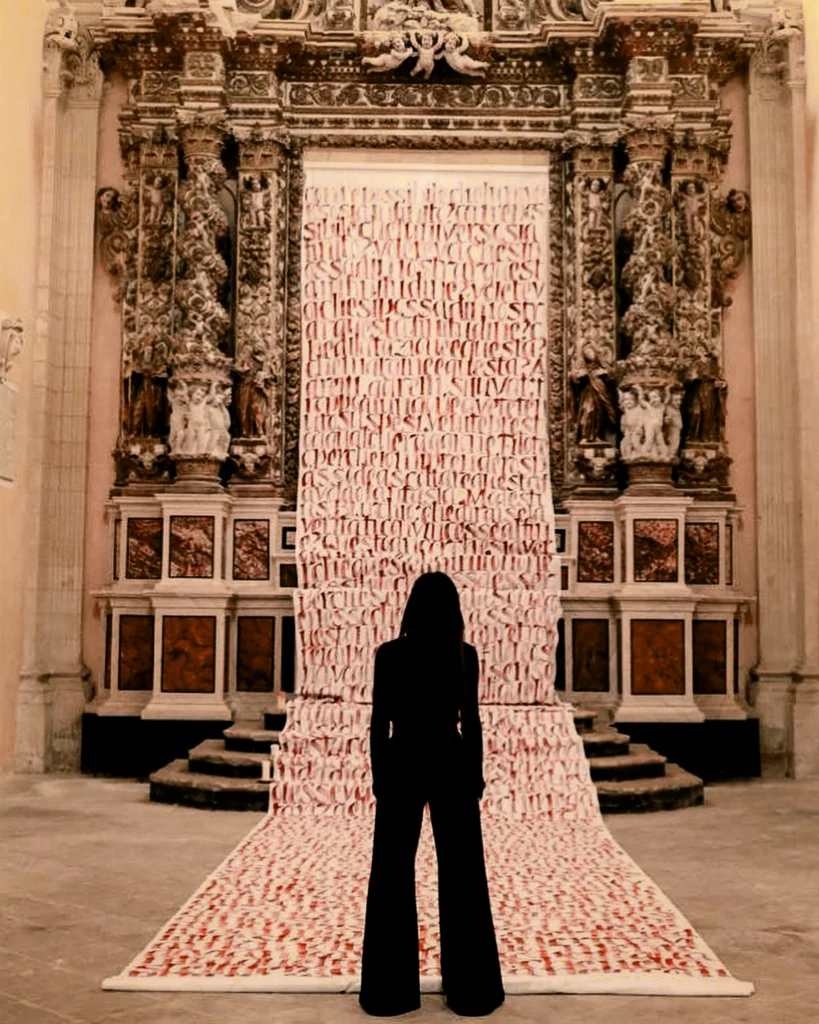
Marta Lagna at San Francesco della Scarpa – Lecce
Giordano Bruno, freedom of thought written across 20 metres of fabric
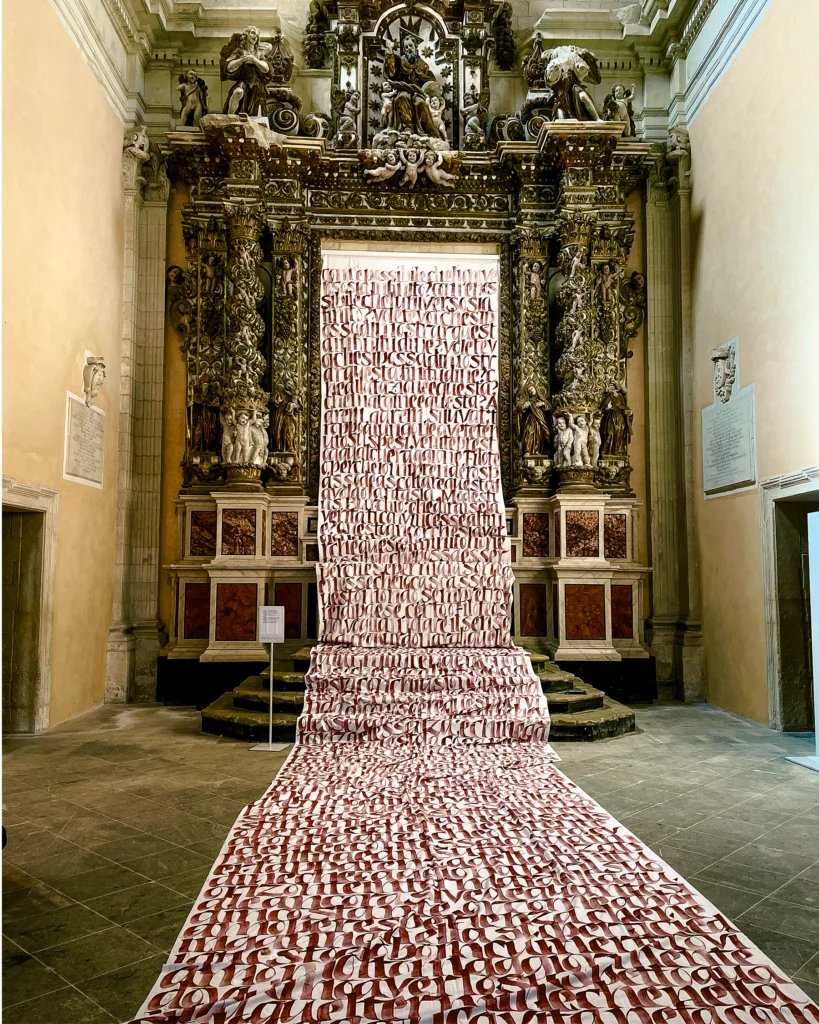
A 20-metre-long, 3-metre-wide canvas unfolds from one of the monumental altars of San Francesco della Scarpa in Lecce. Marta Lagna’s handwriting covers its red and white surface, descending from the architecture towards the floor and transforming the space into a vast contemporary page.
It is the first work of this scale created by Marta Lagna and was conceived for Fiera d’Arte Messapia, a contemporary art event that brought exhibitions, installations and performances to several historic locations across Lecce in 2023.
From 24 April to 7 May 2023, more than sixty artists presented painting, sculpture, installations and performances within some of the city’s most significant spaces.
On 27 April, Marta Lagna’s live painting performance at San Francesco della Scarpa became part of the fair’s programme. The intervention, however, extended beyond the performance itself: writing became a site-specific installation conceived to engage with both the scale and history of the architecture.
A canvas born from architecture
San Francesco della Scarpa is one of the most evocative spaces within the former Convitto Palmieri complex. A deconsecrated church described as a “jewel without a façade”, it preserves the monumental presence of its altars, the breadth of its interiors and the decorative richness of Lecce’s historic architecture.
This sense of scale became the starting point for the intervention.
The canvas is not simply hung inside the church: it takes possession of the space and follows its vertical dimension. From the top of one of the altars, it descends along the presbytery steps before extending across the nave.
The fabric becomes a passage between architecture and language, between the monumental dimension of the building and the physical presence of handwriting.
Giordano Bruno enters the space
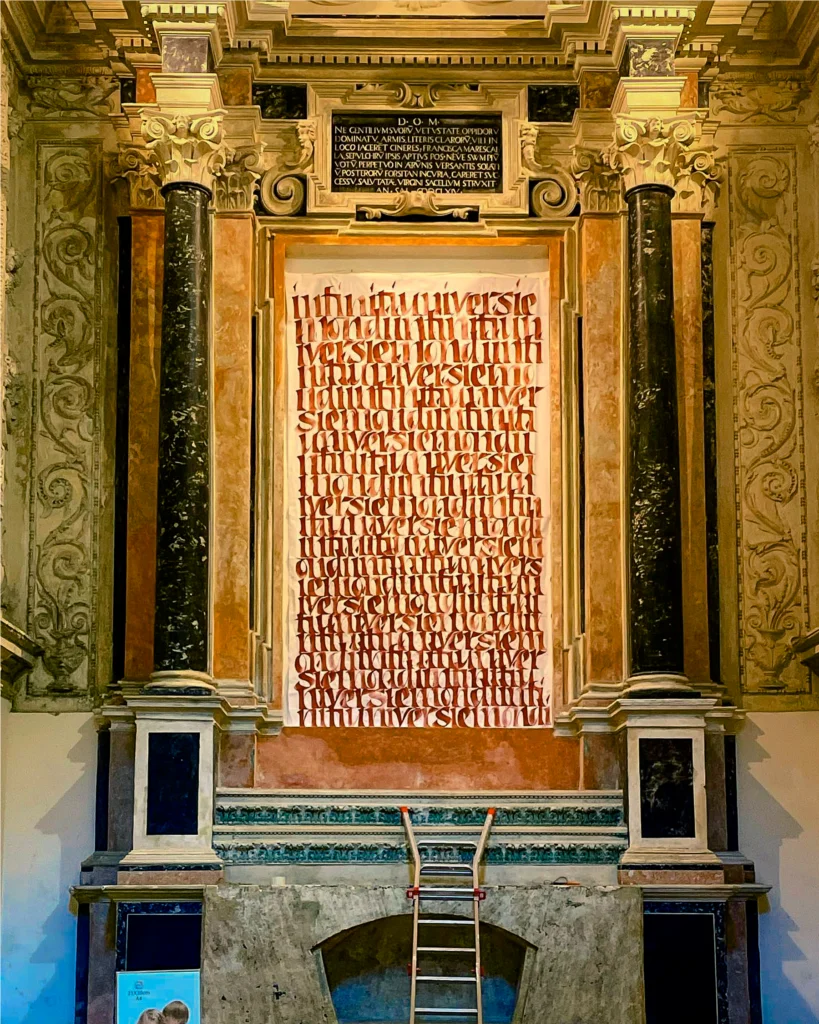
The text selected by Marta Lagna comes from the first dialogue of De l’infinito, universo e mondi by Giordano Bruno.
The intention is not to illustrate the philosopher’s ideas or translate them into an image. Instead, Marta Lagna brings selected words out of the pages of a book and transforms them into visual matter.
Writing gradually takes over the canvas. Words become rhythm, density and movement.
Philosophy enters the architecture through the physical gesture of calligraphy.
Freedom as the material of the work
The choice of Giordano Bruno is connected to the enduring force of his figure and the radical nature of his thought.
Bruno was one of the most courageous thinkers in Western philosophy. He refused to renounce his ideas and was ultimately condemned to death by burning in 1600.
Marta Lagna does not attempt to condense centuries of philosophy into a single image. Instead, she allows the words to speak for themselves, giving them a physical and contemporary dimension.
Once written across the canvas, the text is no longer confined to the page. It becomes a monumental sign that visitors can experience with their eyes as they move through the space.
Writing 20 metres of thought
The scale of the work also changes the relationship with calligraphy.
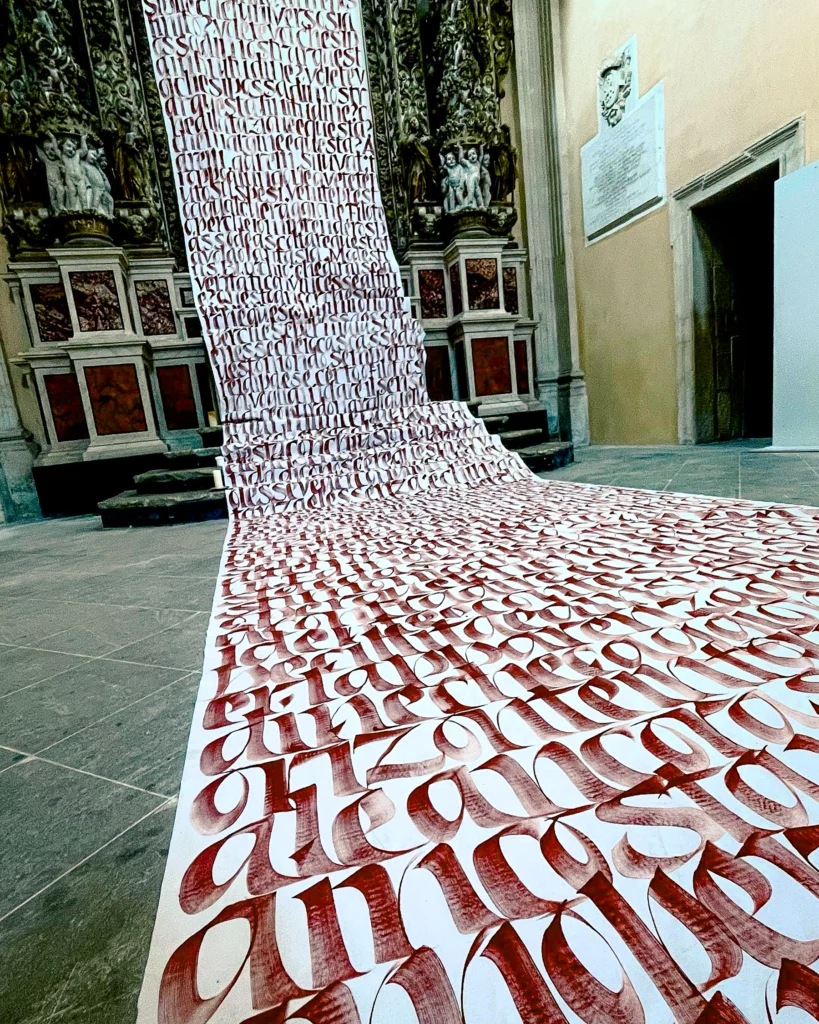
Across a 20-metre surface, handwriting leaves behind the intimate dimension of the sheet of paper and enters the territory of installation. The repeated movement of the hand builds a continuous visual texture, almost like a woven fabric.
Red and white engage with the architecture and materials of the altar, creating a dialogue between historic ornament and the essential presence of contemporary fabric.
Words become surface. Surface becomes space.
Here, Marta Lagna’s calligraphy moves beyond the function of writing to become a form of environmental art.
A performance that becomes an installation
The work was conceived within Fiera d’Arte Messapia as a live painting performance, yet its final form extends beyond the moment of performance.
A gesture normally associated with the private dimension of handwriting and the page is brought before an audience and expanded to the scale of architecture.
Visitors therefore witness not simply the creation of an artwork, but its physical construction: word after word, gesture after gesture, the canvas takes shape within the space.
Writing as an act of freedom
For Marta Lagna, calligraphy is a way of taking words beyond their original context and allowing them to encounter new places.
At San Francesco della Scarpa, this principle reaches an unprecedented scale.
Giordano Bruno’s writing crosses a monumental canvas, while the canvas crosses the architecture.
A thought born centuries ago returns to occupy a contemporary space, continuing to question those who encounter it.
The work does not seek an answer. It creates a space for a question: how powerful can a word become when it returns to being matter?
Fiera d’Arte Messapia, Lecce
The installation was created as part of Fiera d’Arte Messapia, a contemporary art event that, in 2023, brought exhibitions, installations and performances to several locations throughout Lecce’s historic centre.
San Francesco della Scarpa hosted one of the event’s sections, alongside venues including the former Conservatorio Sant’Anna, Palazzo Turrisi, Galleria Maccagnani, MUST and Fondazione Palmieri.
Marta Lagna’s intervention became part of this programme through a practice that connects contemporary art, writing and architectural heritage.
The 20-metre canvas is more than a vast written surface. It is an attempt to bring a philosophical voice from the past into dialogue with a historic place and the present, using calligraphy as a means of connection.
A page becomes a canvas. The canvas becomes architecture. And the words continue to speak.
PROJECT SUMMARY
PROJECT
San Francesco della Scarpa Installation
CLIENT / BRAND
Fiera d’Arte Messapia
INTERVENTION
Site-Specific Installation · Live Painting · Artistic Calligraphy · Contemporary Art
DIMENSIONS
20 × 3 metres
YEAR
2023
LOCATION
San Francesco della Scarpa, Lecce · Italy
CONCEPT
A monumental site-specific calligraphic installation inspired by the first dialogue of De l’infinito, universo e mondi by Giordano Bruno. A 20-metre canvas is handwritten by Marta Lagna and suspended from the monumental altar of San Francesco della Scarpa, creating a dialogue between philosophy, language, contemporary art and historic architecture. Writing transforms the text into a visual surface, bringing a reflection on freedom of thought into public space.