
Masseria Visciglito
Due tele ereditate, la musica popolare e la memoria di una terra
For Masseria Visciglito, Marta Lagna creates an intervention that brings together family memory, Salento folk music and textile tradition.
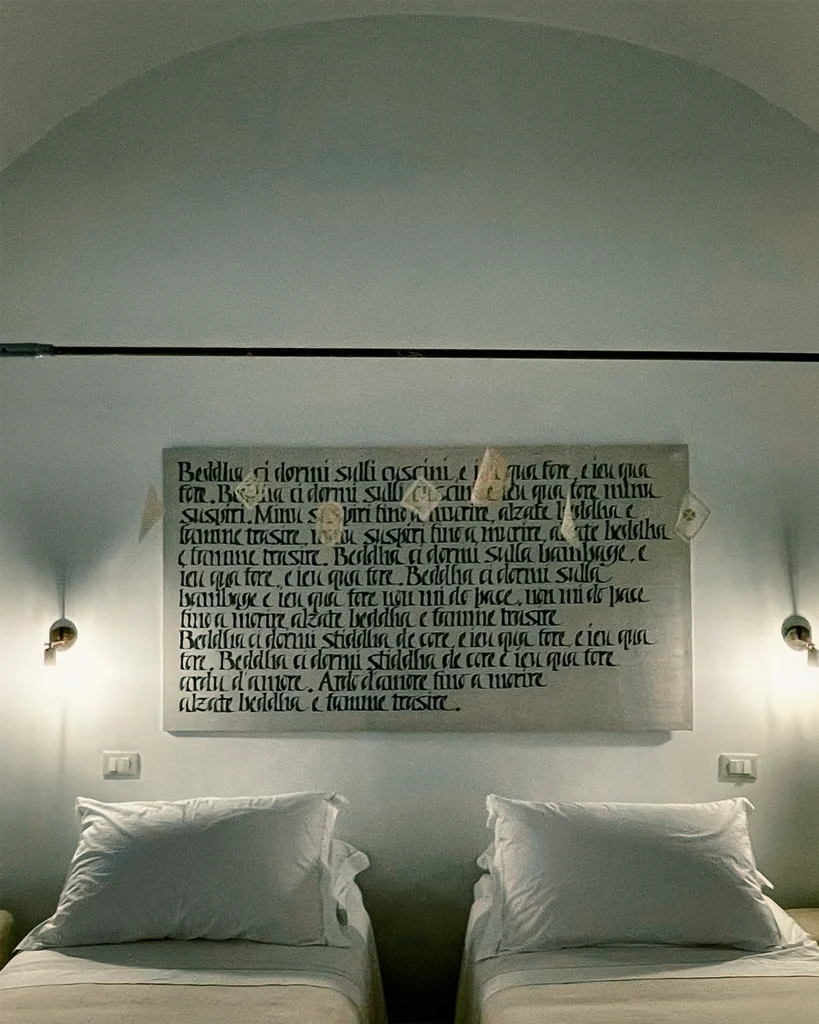
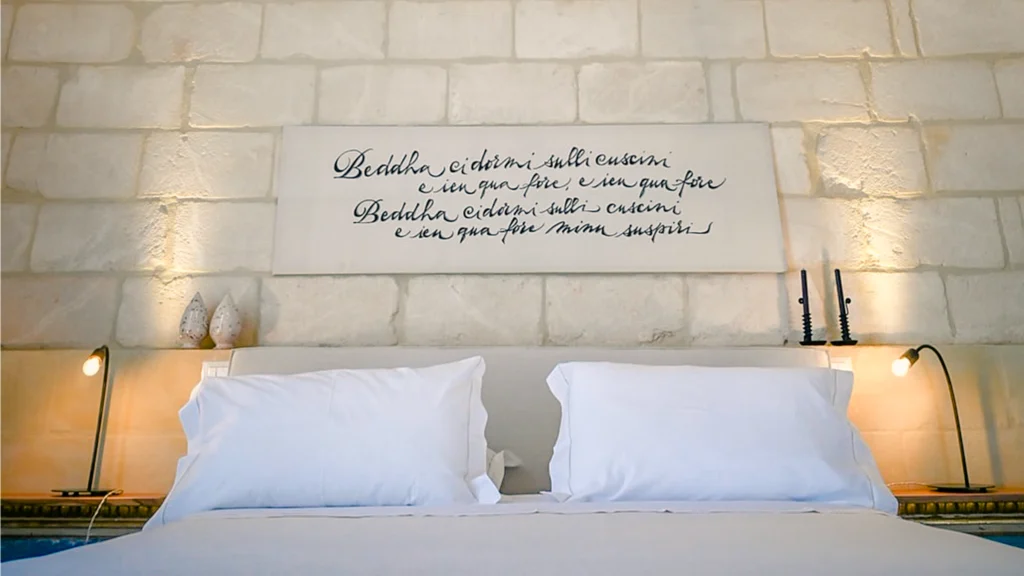
At the centre of the project are two large works created on precious antique fabrics inherited from her mother, used as surfaces for writing. One of them features the text of “Beddha ci dormi”, a song from Salento’s folk tradition deeply connected to love, passion and suffering.
The project emerges from the encounter between private and collective memory. Inherited fabric, traditional embroidery, the language of folk music and the architecture of the masseria become elements of a single narrative.
Folk Music Becomes Calligraphy
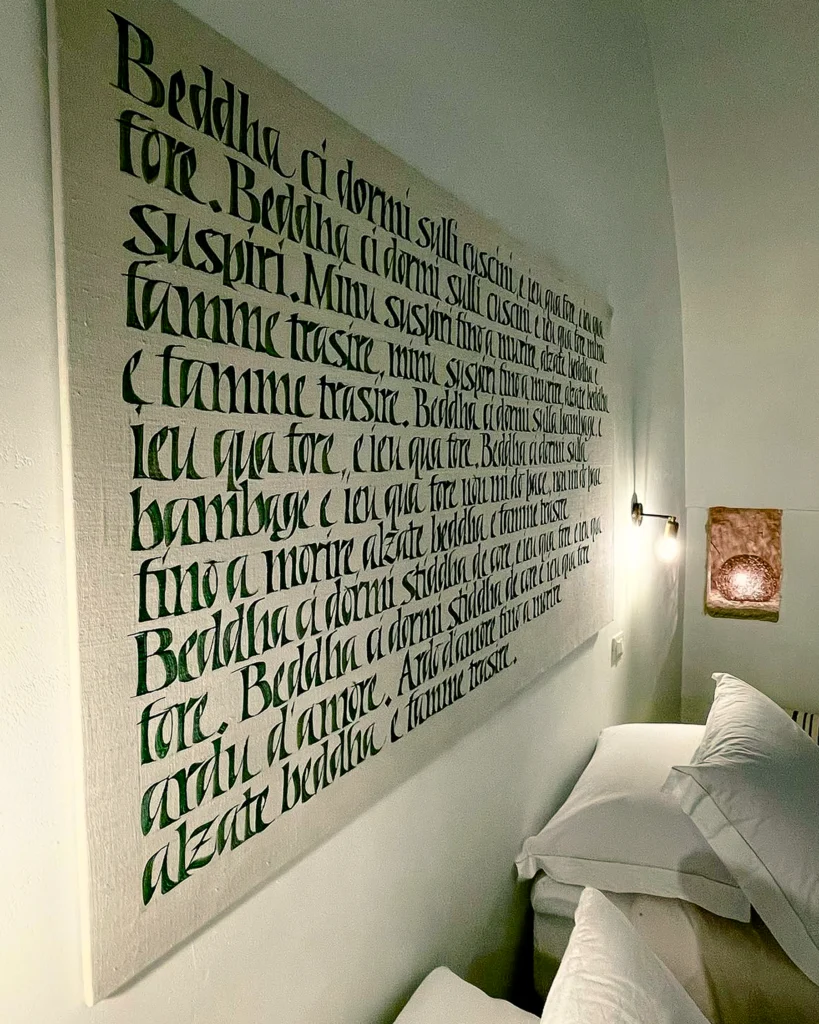
The first textile work is positioned above the headboard of a bed, inside one of the rooms of the masseria.
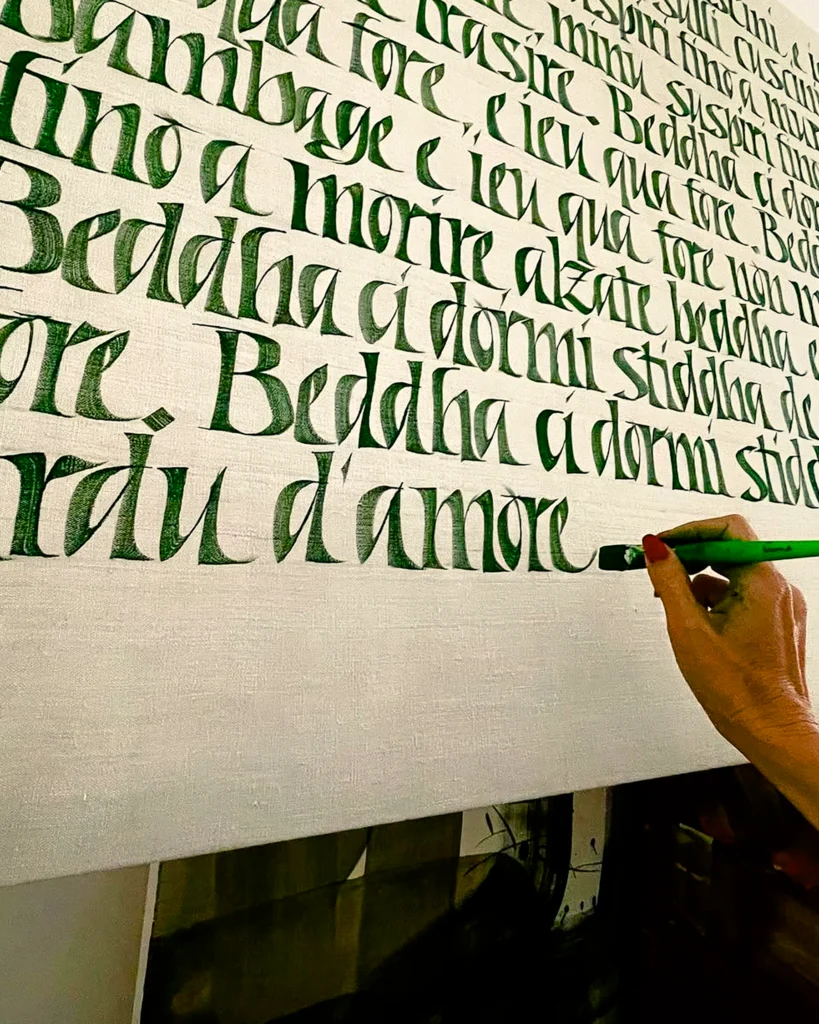
Lecce stone frames the antique fabric, while Marta Lagna’s calligraphy moves across its surface, transcribing verses from “Beddha ci dormi.”
The writing follows the rhythm of the song, transforming the fabric into a suspended page between memory and contemporaneity.
The song expresses love in its most intense forms: desire, waiting, distance and a feeling that can become a fire capable of warming and, at the same time, consuming.
Calligraphy does not illustrate the music. It translates its rhythm into a visual form.
The Fire of Passion on Fabric
The second work carries the same theme onto a larger surface through a much denser form of writing.
Words accumulate into a continuous, almost obsessive texture, visually conveying the intensity of Salento folk music.
The movement of the hand creates a rhythmic sequence reminiscent of the repetition of traditional verses and the hypnotic beat of the tambourine.
The phrase becomes matter.
Writing becomes rhythm.
Calligraphy becomes visual sound.
Embroidery by the Women of Salento
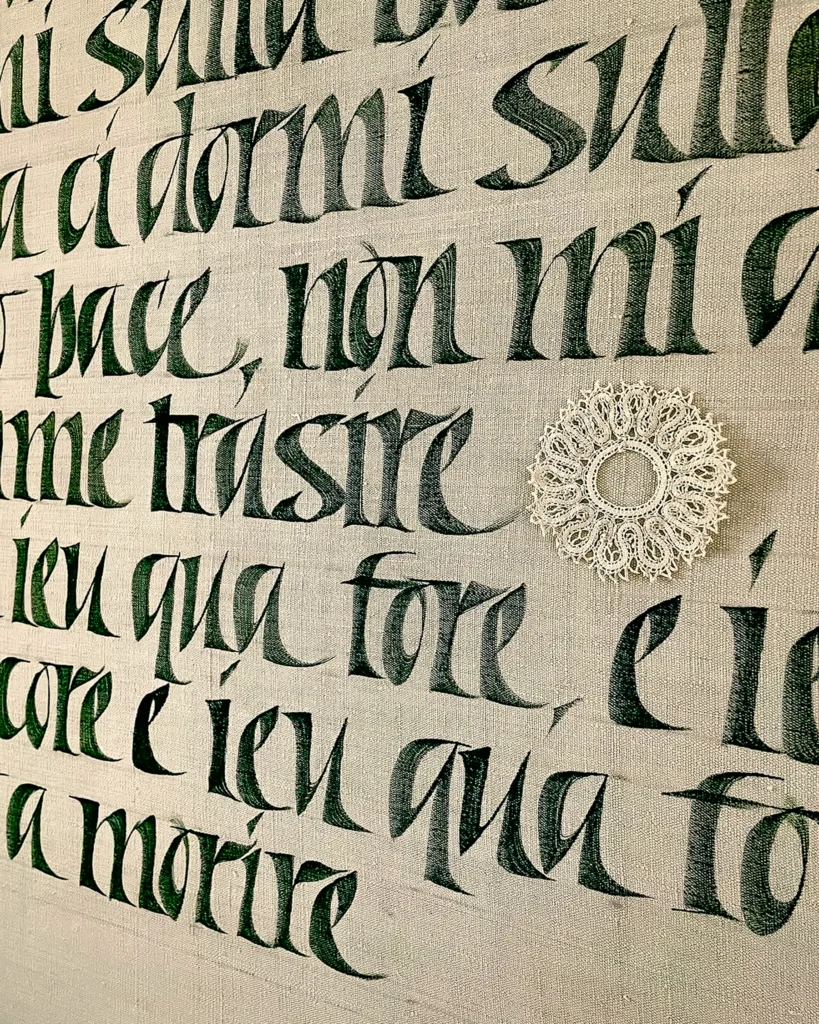
Alongside the textile works are small masterpieces of traditional embroidery, made by women from Salento in generations past.
Fragile yet precious, they bear witness to a domestic craft passed down through generations of patient and skilled hands.
The embroideries are not presented as mere decorative elements. Hung directly from the structural beam of the room, they are left free to move with the air.
The sirocco passes through the spaces, opening the doors and bringing the Salento landscape into the room.
The small embroidered pieces thus become sculptures of air: light, mobile presences that connect the interior of the masseria with the territory surrounding it.
Private and Collective Memory
Project brings together different forms of memory.
The fabric inherited from her mother belongs to a personal history. The embroidery belongs to a shared craft culture. Folk music carries an even broader memory, rooted in the language, emotions and history of Salento.
It is within the masserie that these dimensions can meet.
Independent architectural structures deeply connected to their territory, masserie preserve stories, gestures and traces of life that time never completely erases. Their strength also lies in their ability to reactivate memory through matter: a stone, a fabric, an object, a song.
At Masseria Visciglito, calligraphy enters this system of signs without imposing itself upon it.
It interprets it.
A Love Song Written Above the Bed
The calligraphic panel above the bed is the most intimate element of the intervention. Created on an antique fabric inherited from her mother, it carries part of “Beddha ci dormi,” one of the most poignant expressions of Salento’s folk music tradition.
The choice of the song introduces an actual love serenade into the room. Its words evoke a lover standing outside the house, calling to the woman who is sleeping and waiting for her sighs. Calligraphy creates a powerful connection between the song and the physical space: the verses are written directly above the bed, beside the pillows, turning the architecture of the room into the very setting of the story being told.
The support itself becomes part of the meaning. It is not a neutral surface, but an antique and precious fabric inherited from the family, through which private memory enters a collective narrative. The traditional serenade and a family history converge in a single object.
The fluid cursive of the calligraphy dialogues with the materiality of the exposed limestone and the warm light of the room. Fabric, stone and writing create an image suspended between artwork and interior element: a discreet presence designed to be discovered slowly, like a story passed down through generations.
Pizzica, Taranta and a Land That Vibrates
Salento folk music has a visceral relationship with the territory.
Pizzica and taranta have shaped the cultural imagination of Salento for centuries, holding together opposing emotions: love and pain, desire and absence, passion and torment.
These are forms of music that shake the body and, through verses and traditional songs, have carried stories and emotions from one generation to the next.
In Marta Lagna’s project, this energy moves from music into writing.
The words of the song become signs, the signs become surfaces, and the surfaces enter the architecture.
What vibrates is not only the lettering, but emotions and memories.
The Masseria as a Space of Memory
The intervention is therefore not conceived as simple decoration.
Marta Lagna works with what already belongs to the place, creating a relationship between the history of the masseria and the cultural memory of the territory.
Antique fabric, stone, embroidery, music and calligraphy share the same understanding of time: a slower dimension shaped by repeated gestures, materials that age and knowledge passed from one generation to another.
Tradition is not reconstructed as a nostalgic image.
It returns through new gestures.
An Embrace from Past to Present
The works created for Masseria Visciglito become an homage to Salento and to its ability to preserve memory through matter.
The two textile works are not simply interior elements, but calligraphic and textile installations in which a family history encounters that of a community.
Writing brings music into the space.
Embroidery brings craftsmanship into the present.
Architecture holds them both.
And when the sirocco moves through the room, gently shifting the embroideries suspended from the beam, past and present seem to meet for a moment.
PROJECT SUMMARY
PROJECT
Beddha ci dormi
CLIENTE / BRAND
Masseria Visciglito
INTERVENTION
Artistic Calligraphy · Textile Art · Interior Art · Site-Specific Installation
YEAR
2025
LOCATION
Masseria Visciglito · Salento, Italy
CONCEPT
A calligraphic and textile art intervention that brings together private and collective memory through two works created on antique fabrics inherited from the artist’s mother, the writing of a song from Salento’s folk music tradition and traditional handmade embroidery. The project brings calligraphy, textile and architecture into dialogue, transforming the memory of the territory into a contemporary experience within the masseria.