
Psychiatric Hospital
The collaboration with Urbex Salento: from abandoned walls to poetry, an act of care
Almost three weeks have passed since my experience with Urbex Salento inside an abandoned psychiatric hospital, a building that has been left to decay and vandalism for years. Yet the sensations I experienced in those rooms are still very much with me.
Silence seemed to dominate everything, interrupted only by the flight of swallows and the rustling of vegetation that has gradually taken over the building through windows and cracks.
And then there was the long black whip snake that greeted us as soon as we entered. An unexpected encounter that immediately awakened my fascination with symbolism: an animal I have always particularly loved, and one that carries powerful meanings of transformation, rebirth and transition in symbolic and esoteric traditions.
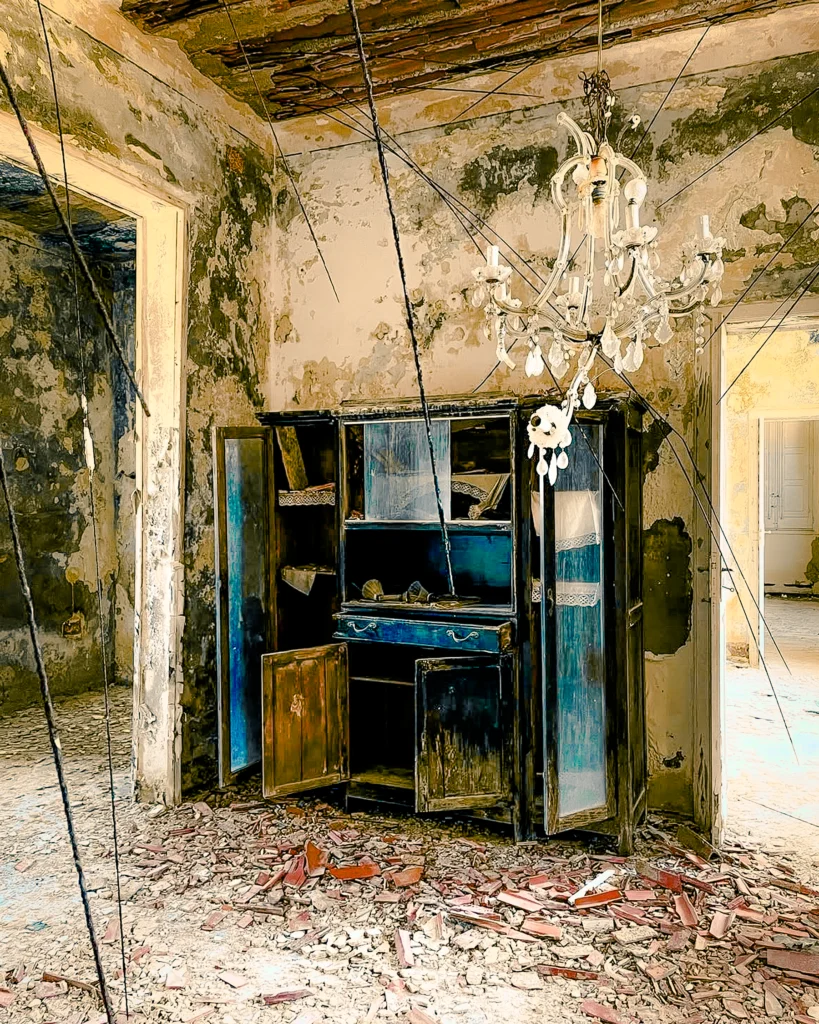
Entering a place like this means confronting something that goes beyond architecture. These are spaces that preserve traces, absences and signs of lives we can no longer see, yet which somehow remain present.
As Daniela from Urbex Salento wrote, these experiences “are not only a journey through ruins, but a journey through the folds of human memory.”
And this is where the collaboration began.
When abandonment meets writing
Faced with rooms heavily vandalised and violated by time and neglect, our response was not to add more noise.
We chose art.
We chose care, respect and, above all, the possibility of giving a voice again to a place that had known silence for so long.
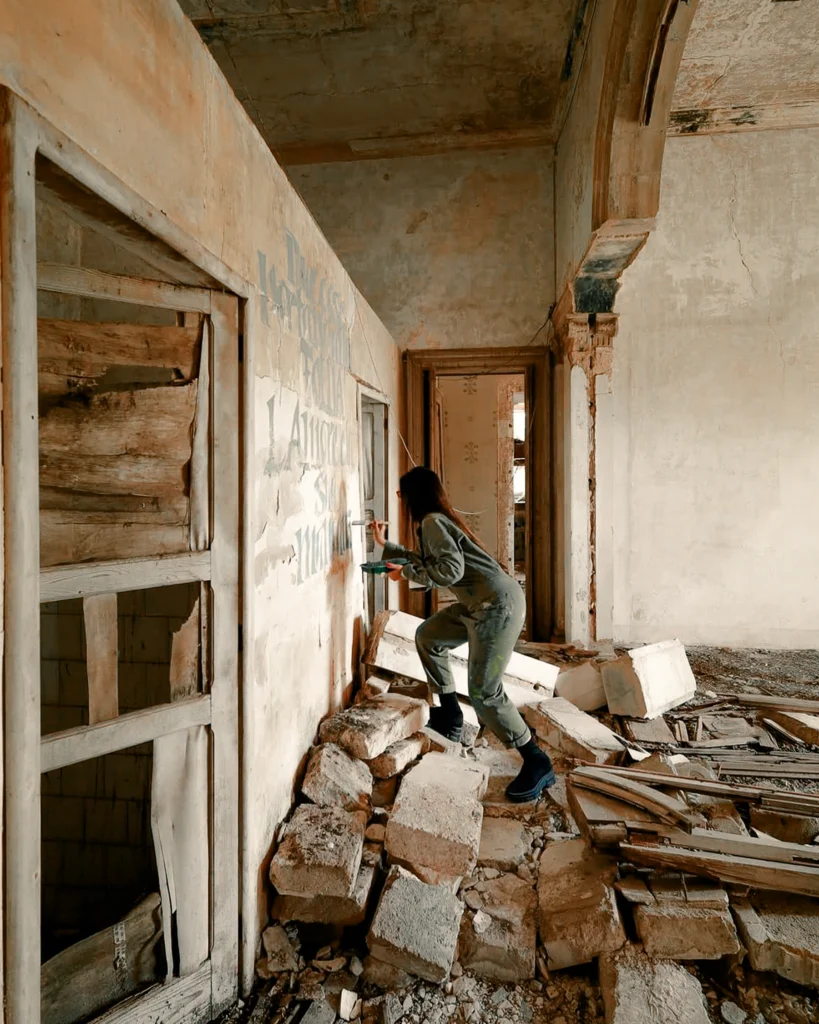
Calligraphy enters the former psychiatric hospital not to erase its traces, but to engage with what remains. Peeling walls, old layers of paint, cracks and marks left by abandonment become part of the intervention itself.
Writing does not cover the history of the place. It moves through it.
Alda Merini on the walls of the former hospital
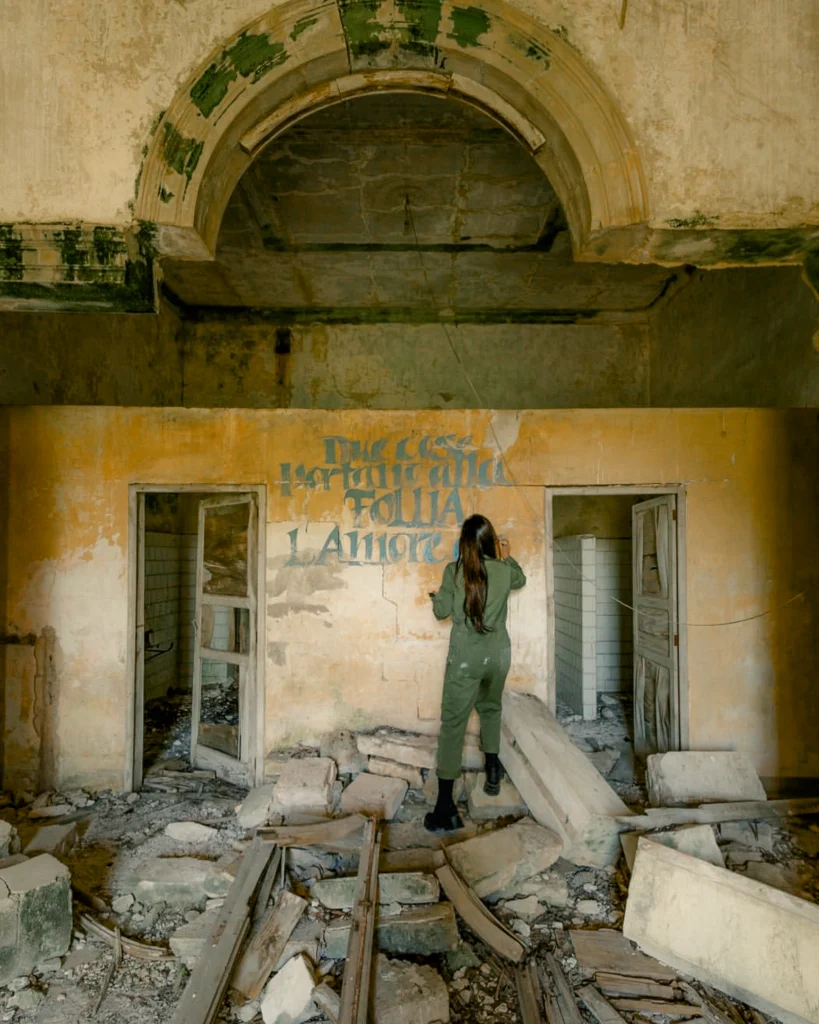
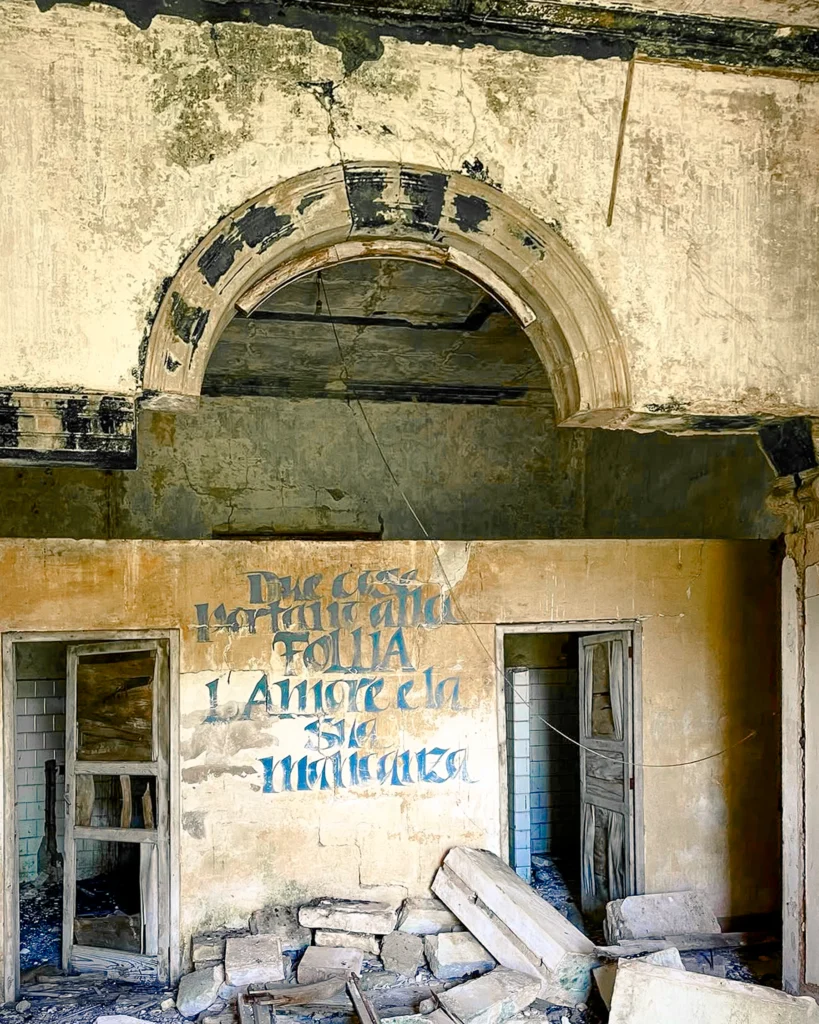
In one of the rooms, the chosen words come from Alda Merini:
“Two things lead to madness: love and its absence.”
A short, direct sentence that becomes impossible to read without immediately connecting it to the nature of this place.
Calligraphy brings the words onto the wall and transforms them into a physical sign, allowing the space itself to complete their meaning.
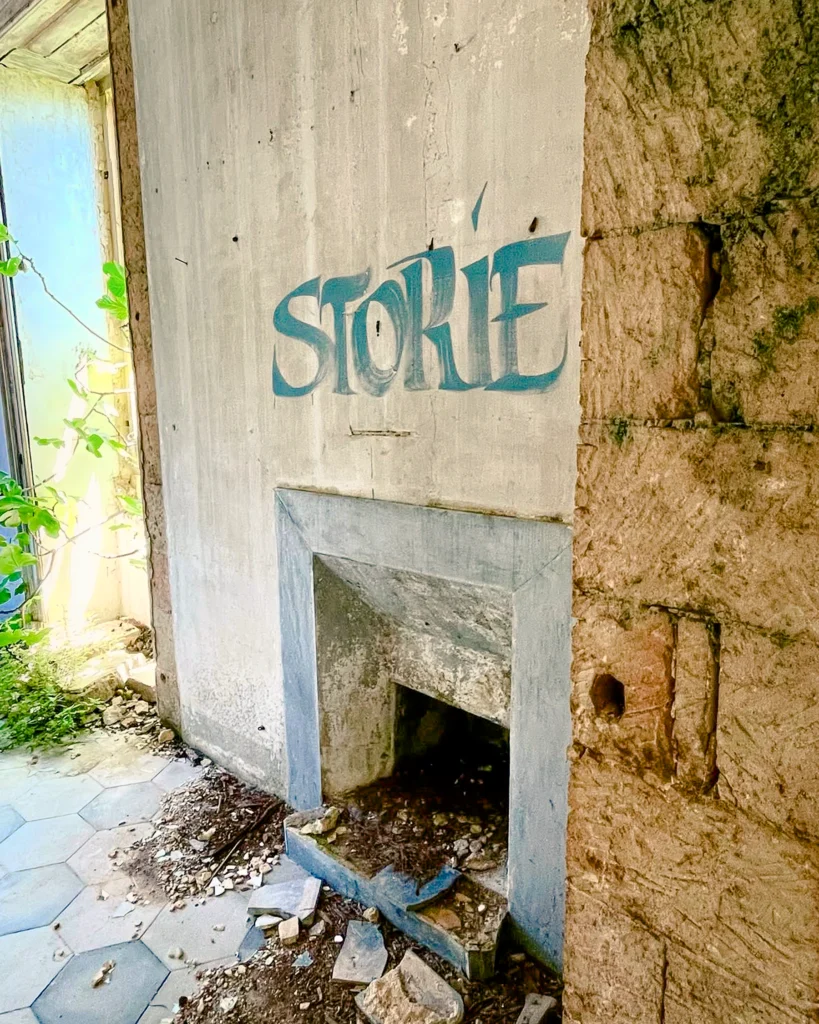
The powder blue chosen for the lettering emerges from older layers of paint and meets the melancholic ochre still visible across the walls.
There is no attempt to make something old look new.
Instead, the colour seems to belong to the wall already, as if it had remained hidden beneath the surface, waiting to be seen again.
A word to give a voice back
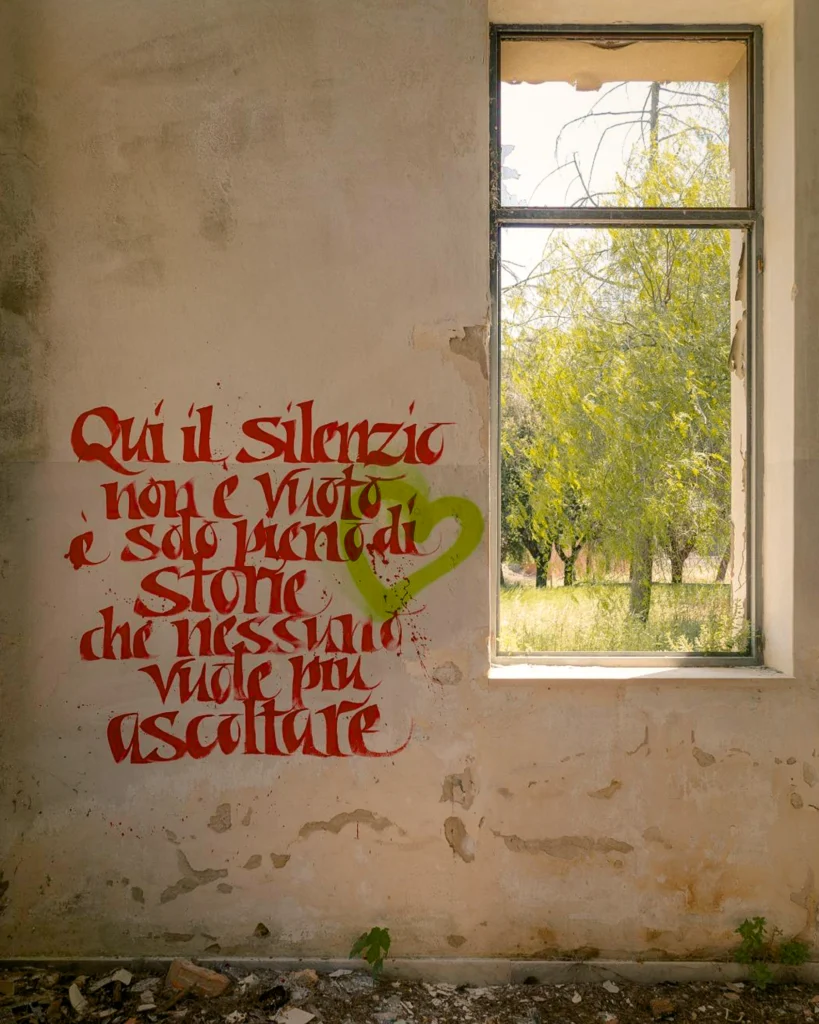
Alongside Merini’s words appears another simple word: “STORIES.”
A particularly meaningful word inside a building that contains so many stories while, at the same time, seems to have lost them.
Writing it means directing attention towards what is no longer visible.
Not the rooms as ruins, nor the aesthetic fascination of abandonment, but the people, experiences and lives that once passed through them.
Calligraphy therefore becomes a way of giving a voice back to what time has progressively erased.
Writing across the traces of time
Working on a wall marked by abandonment means accepting that the surface is never neutral.
Cracks, layers of paint, worn surfaces and imperfections become part of the artwork. The hand follows a material already charged with history, while the act of writing becomes a physical gesture of approaching and listening to the place.
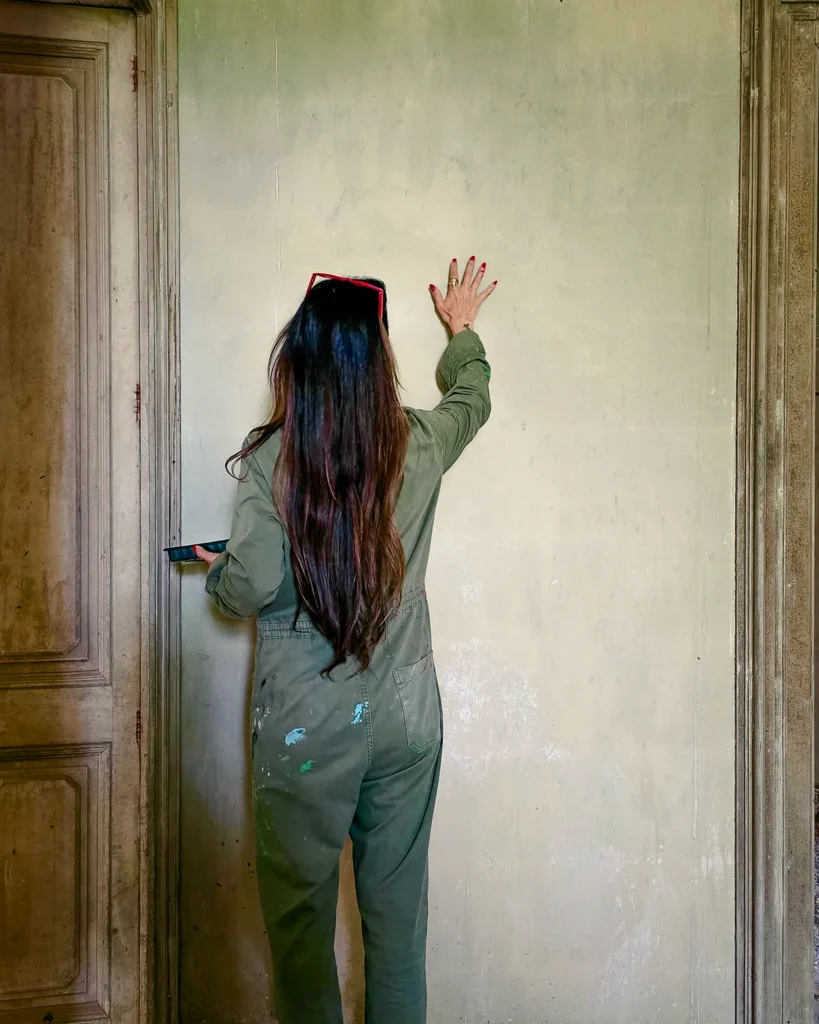
In one of the images, Marta appears from behind, wearing a work suit marked with paint, as she reaches towards the wall.
It is a simple gesture, but it captures the nature of the intervention: not painting over a place, but working with what the place gives back.
Writing becomes a form of listening.
A place that did not need to be spectacularised
Urban exploration often invites us to look at abandoned buildings through their most dramatic qualities: decay, ruins and everything transformed by time.
Here, however, the collaboration with Urbex Salento opens up a different perspective.
The aim is not to spectacularise abandonment, but to enter it consciously.
The fascination of these architectures cannot be separated from the memory they contain. For this reason, the calligraphic intervention becomes almost the opposite of the logic of ruin: where something has been destroyed, writing attempts to reconstruct meaning.
Not to restore.
Not to erase.
But to give dignity to an instant.
Ephemeral art and memory
The intervention was conceived deliberately as an ephemeral act.
As Daniela wrote, we were not looking for eternity, but for “the dignity of an instant.”
Those words, colours and gestures will eventually disappear together with the walls that hold them. And it is precisely this impermanence that makes the gesture meaningful.
Not everything that matters has to last.
Sometimes an artwork simply needs to interrupt, even for a moment, the condition of abandonment surrounding a place.
To tell those rooms, and the people who once inhabited them, that they have not been forgotten.
From ruins to poetry
The collaboration between Urbex Salento and Marta Lagna brings together two practices that might initially seem distant: exploring abandoned places and calligraphy.
In reality, both begin with the same impulse: to look at what we normally fail to see.
Urbex Salento enters forgotten places and collects their traces. Marta Lagna works with those traces through writing, transforming a wall into a surface capable of receiving a voice once again.
It is an encounter between photography, exploration, memory and urban art.
And perhaps poetry becomes the point where they meet.
Because in a place that has known suffering, writing a sentence about love and its absence means bringing back to the centre something that the architecture had stopped telling.
“Two things lead to madness: love and its absence.”
A sentence by Alda Merini comes alive again on a wall that will, sooner or later, disappear.
And while time continues to consume the building, for a moment writing does the opposite: it takes care of memory.
PROJECT SUMMARY
PROJECT
Psychiatric Hospital
CLIENT / BRAND
Urbex Salento
INTERVENTION
Artistic Calligraphy · Urban Art · Site-Specific Intervention · Ephemeral Art
YEAR
2026
LOCATION
Ex ospedale psichiatrico · Salento, Italy
CONCEPT
A site-specific calligraphic intervention created through a collaboration between Marta Lagna and Urbex Salento inside an abandoned psychiatric hospital. Marta Lagna’s writing engages with peeling walls, layers of paint and traces of time, bringing Alda Merini’s poetry into a space marked by abandonment. Powder blue lettering emerges from the existing surface, transforming the wall into a site of memory and giving a voice back to a place shaped by silence and forgotten stories.