
Marinero Bistrot
Sabrina Merolla’s idea becomes an invitation to shared vision, partnership and the art of building together
In the heart of Otranto’s historic centre, a white wall becomes the starting point for a story about travel, shared ambition and the power of building something together.
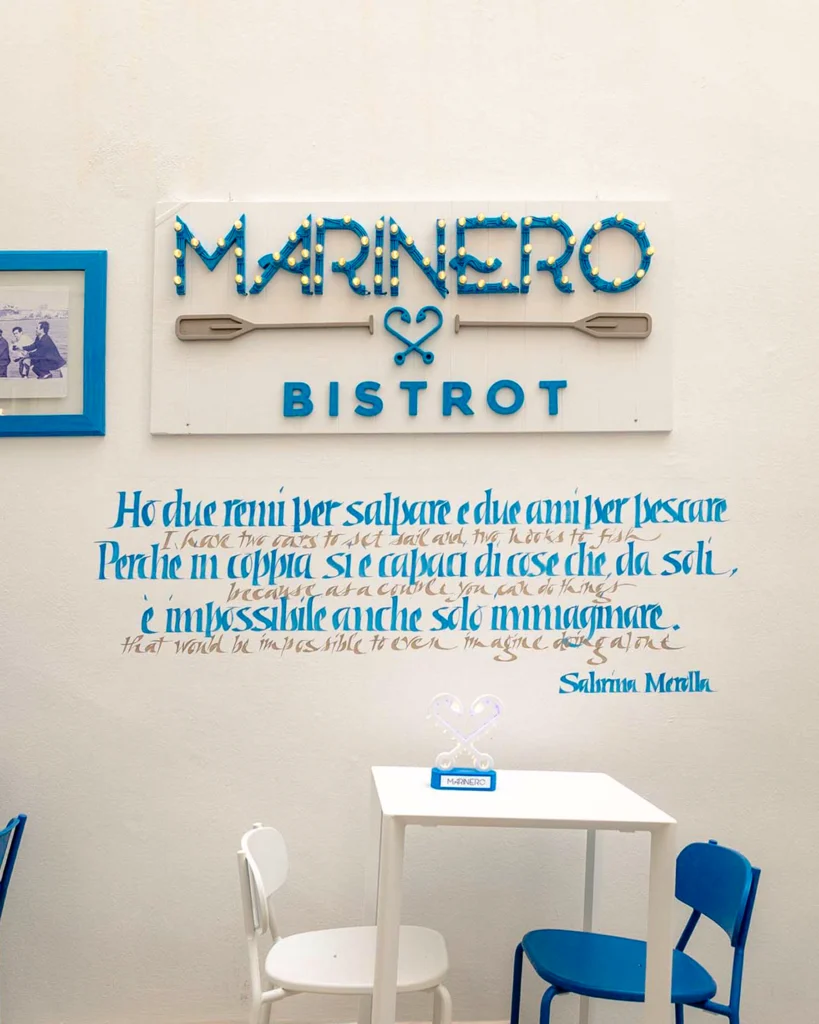
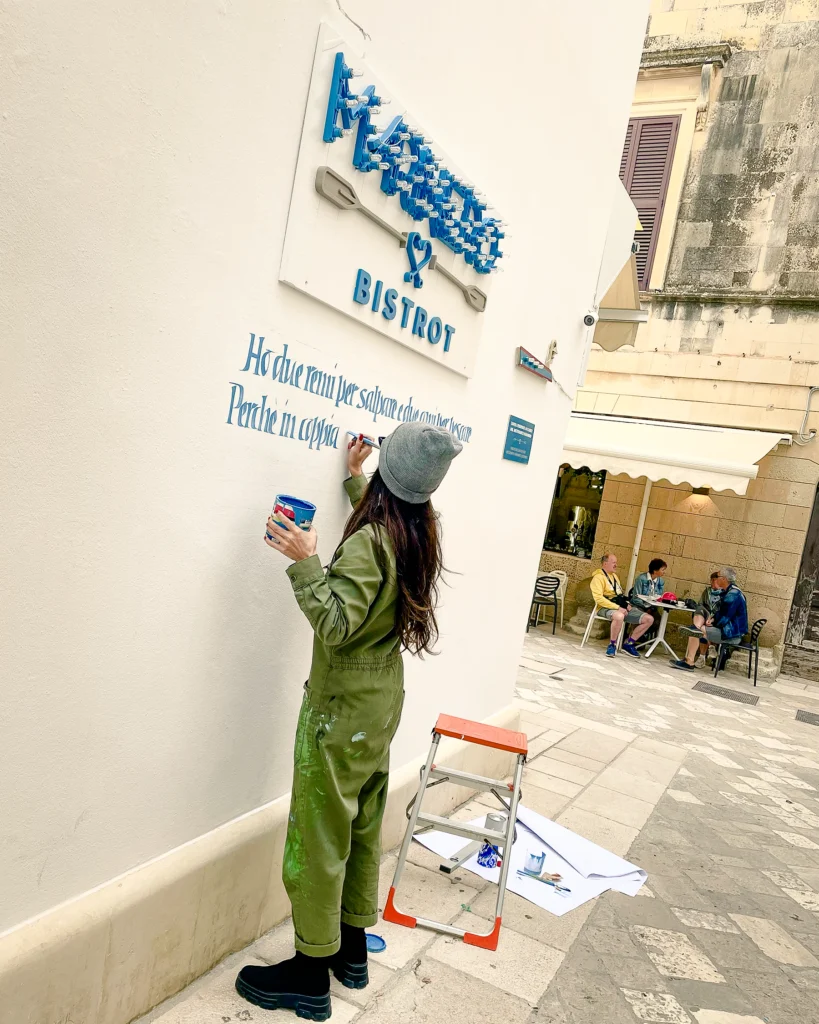
For Marinero Bistrot, Marta Lagna transforms a phrase by Sabrina Merolla into calligraphy, using a metaphor deeply rooted in the language of the sea:
“I have two oars to set sail and two hooks to fish, because as a couple you can achieve things that, alone, would be impossible even to imagine.”
The words are not simply about love. They are about building.
About bringing two people, two energies and two visions together to follow a shared path and reach horizons that might otherwise seem out of reach.
This is the starting point for Marta Lagna’s intervention: not simply a decorative treatment of the façade, but writing as a way of making the philosophy behind the project visible.
In the heart of Otranto’s historic centre, a white wall becomes the starting point for a story about travel, shared ambition and the power of building something together.
For Marinero Bistrot, Marta Lagna transforms a phrase by Sabrina Merolla into calligraphy, using a metaphor deeply rooted in the language of the sea:
“I have two oars to set sail and two hooks to fish, because as a couple you can achieve things that, alone, would be impossible even to imagine.”
The words are not simply about love. They are about building.
About bringing two people, two energies and two visions together to follow a shared path and reach horizons that might otherwise seem out of reach.
This is the starting point for Marta Lagna’s intervention: not simply a decorative treatment of the façade, but writing as a way of making the philosophy behind the project visible.
The Sea as a Metaphor for a Shared Project
Sabrina Merolla’s words begin with two essential elements of navigation.
Oars make departure possible.
Hooks make fishing possible.
Simple, tangible tools for facing the sea, they also become metaphors for what each person brings into a relationship: skills, desires, experience and imagination.
The decisive idea arrives in the second part of the sentence:
“Because as a couple you can achieve things that, alone, would be impossible even to imagine.”
Here, partnership is not described simply as emotional connection. It becomes a way of designing a life together.
Two people can build something that goes beyond the sum of their individual possibilities. They can choose a direction, face a crossing, change course and reach a destination they might never have imagined reaching alone.
The sea therefore becomes the natural horizon for a broader idea: every meaningful project begins with the ability to share a vision.
Marta Lagna: Turning an Idea into a Place
This is where Marta Lagna’s work comes into focus.
The sentence moves beyond brand communication and beyond a text encountered inside the restaurant. It reaches the exterior wall, becoming a visual presence in direct dialogue with Otranto’s historic architecture.
Calligraphy becomes part of the place.
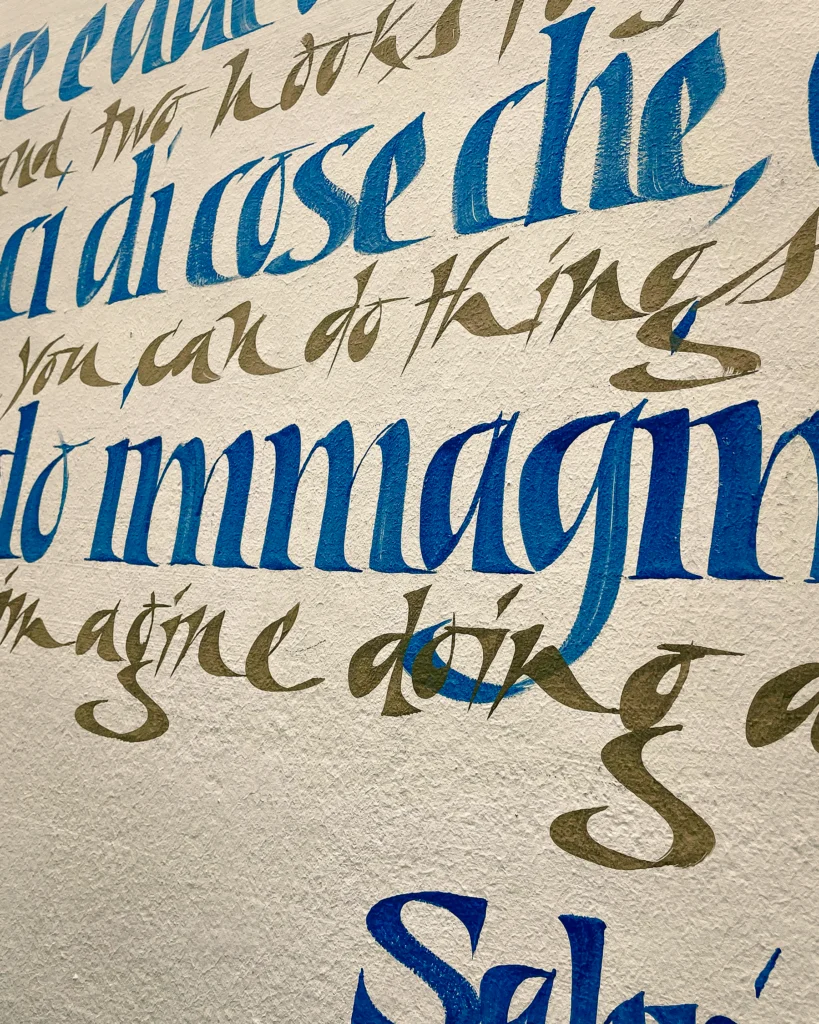
Italian words appear in an intense sea blue, drawn through a fluid yet structured cursive hand. Beneath each line, an English translation introduces a finer layer of lettering, extending the message to Otranto’s international audience.
Language becomes a design element.
Two scripts create a visual rhythm across the wall, transforming a sentence into a form of architectural composition.
Words follow the surface, occupy its scale and change the way the wall is perceived.
Calligraphy comes into its own as part of the project.
It becomes part of its identity.
A Wall That Tells the Story of Marinero
Marinero is rooted in the sea, food, hospitality and the memory of Otranto.
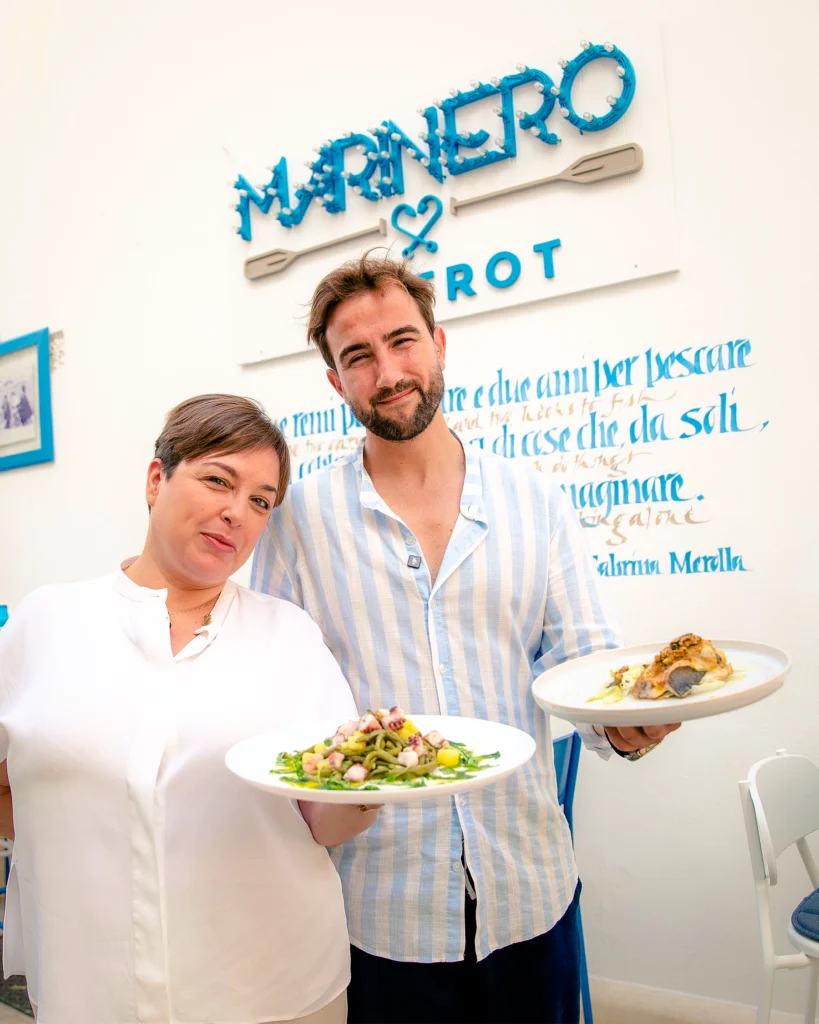
Francesca Paiano, with more than thirty years of experience in Otranto’s restaurant scene, represents the heart of its hospitality. Matteo Iaia, raised between his mother’s kitchen and the bar founded by his father Giovanni Iaia, brings a contemporary sensibility to the dining room, mixology and guest experience.
It is an identity built over time while remaining open to the future.
The sentence chosen for the wall captures precisely this dimension.
Two people, two tools, one course.
It can speak to a couple, but also to anyone who has built something together with another person: a restaurant, a business, a family, a creative project or a life.
Public Art Meets Place Identity
One of the most compelling aspects of the intervention is its public dimension.
The wall is not confined to a private interior reserved for restaurant guests. It forms part of Otranto’s urban landscape.
Anyone walking through the historic centre can encounter the words without necessarily knowing Marinero, entering the restaurant or even knowing who Marta Lagna is.
Writing therefore becomes part of the landscape.
A phrase that begins as a personal thought takes on a collective dimension when transferred into public space.
This is central to Marta Lagna’s practice: using calligraphy to give physical form to an idea and placing it directly where that idea can be experienced.
A Phrase About Going Further
“I have two oars to set sail and two hooks to fish” is, ultimately, an invitation to leave.
But not to leave alone.
The phrase suggests that certain destinations become possible only when there is someone with whom to share the direction.
This is where the metaphor of the sea acquires a broader, project-based meaning.
Setting sail means having the courage to leave familiar ground. Fishing means searching for something we do not yet possess. Navigating together means accepting that a course can be shaped through dialogue, collaboration and mutual trust.
Above all, it means recognising that another person can expand what we are capable of imagining.
The Marinero wall therefore tells much more than a romantic story.
It speaks of the possibility of building a shared vision.
An Image That Has Become Part of Otranto
Over time, the calligraphy on Marinero’s façade has also become a recognisable element of the place.
The wall invites photography, sharing and spontaneous encounters. Couples and visitors can stop, read the words, photograph them and carry the image with them as part of their memory of Otranto.
It communicates without demanding attention.
Rather than promoting a product or functioning as conventional signage, the calligraphy becomes an integral part of the place.
A single sentence becomes a way of expressing identity.
This is where the project finds its strength: transforming a wall into a visible thought and bringing identity, place and storytelling together.
Calligraphy as a Design Direction
In the Marinero project, calligraphy is not an ornamental element added to enrich an environment.
It is the tool through which a vision takes shape.
Sabrina Merolla’s phrase already contains the concept: the sea as departure, partnership as strength, collaboration as possibility and imagination as the horizon.
Marta Lagna brings these ideas onto the architectural surface and makes them part of the experience of the place.
Oars to set sail. Hooks to fish. Two people capable of imagining what neither could see alone.
PROJECT SUMMARY
PROJECT
Marinero Bistrot
CLIENT / BRAND
Marinero Bistrot – Otranto
INTERVENTION
Wall Lettering · Artistic Calligraphy · Urban Writing · Brand Identity
YEAR
2024
LOCATION
Via Costantino I, 3 – 73028 Otranto | LECCE
CONCEPT
A phrase rooted in the language of the sea becomes a large-scale calligraphic composition exploring partnership, shared ambition and the power of building together. On Marinero’s exterior wall, writing becomes part of the architecture and an integral element of the place’s identity.