
Santa Maria al Bagno Stairway Mural
In Nardò, a tribute to the sea of Salento
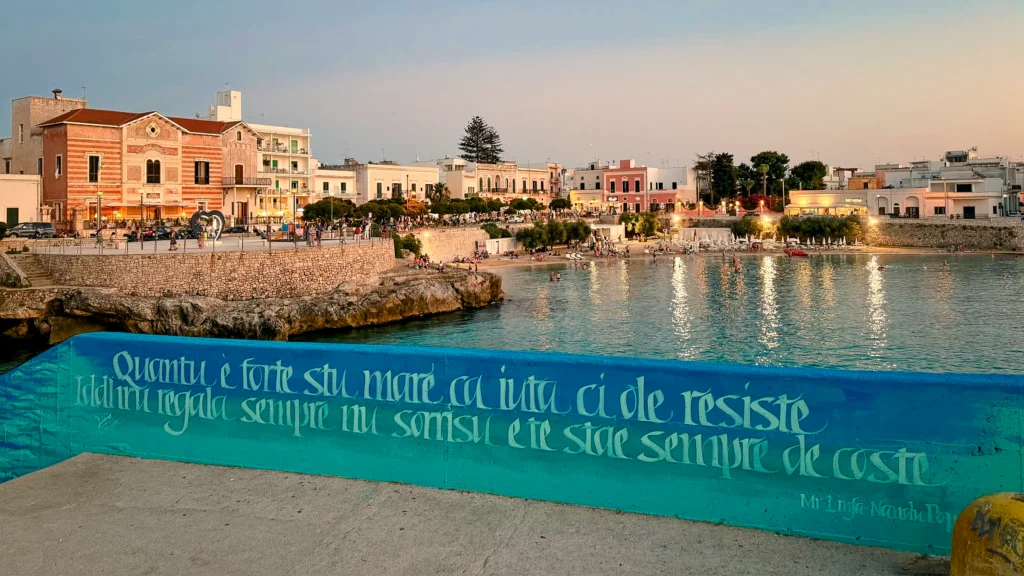
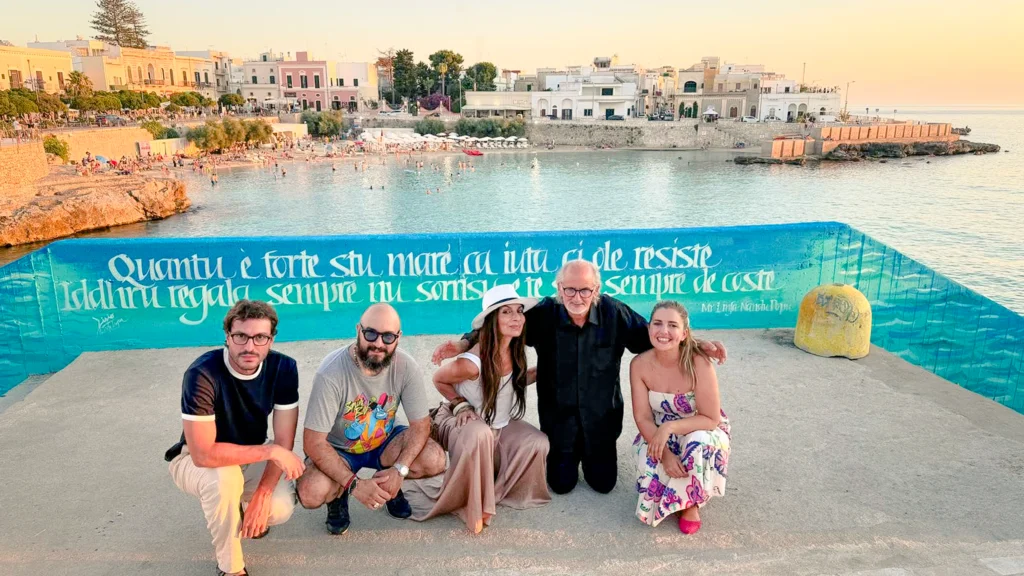
“Quantu è forte stu mare…” Marta Lagna’s Diego Spano mural turns a line born from a song into material, mark, colour and memory. In Santa Maria al Bagno, along Lungomare Emanuele Filiberto, a stairway leading towards the sea has been transformed into a public artwork dedicated to Diego Spano, the Nardò-born artist and musician known as Mr. Linfa.
The project was created to keep Diego’s voice alive through one of his most powerful expressions of love for his homeland, featured in Lu sule a Mile Beach, released in July 2024 and written and performed together with Nandu Popu. Just a few words, spoken in Salento dialect, yet capable of expressing a profound relationship with the sea and the land:
«Quantu è forte stu mare, ca iuta ci ole resiste, iddhu regala sempre nu sorrisu e te stae sempre de coste…»
How strong this sea is, helping those who want to resist. A sea that always gives you a smile and always stays by your side.
This line became the starting point for a project promoted by the Municipality of Nardò, also fulfilling a wish Diego had expressed shortly before his death: to see a line from one of his songs transformed into a mural.
The result goes beyond a street art intervention. It becomes a place of memory and, at the same time, a new element within Santa Maria al Bagno’s urban landscape. Its position allows the artwork to remain in constant dialogue with the sea that inspired the artist’s words.
The stairway as a canvas for street art
Location is not accidental.
The mural covers a stairway and its balustrade leading from the seafront towards the small cove below. A transitional urban surface overlooking the water, previously marked in part by unauthorised graffiti and vandalism.
Art therefore intervenes in an everyday space, transforming it without taking away its original function. The stairway remains a passage, while also becoming a narrative surface: a place to stop, read, observe and recognise part of the area’s history.
Working in this specific location establishes a direct relationship between word and landscape. Diego’s words are not simply reproduced on a wall; they are returned to the environment from which they originated.
The sea is visible to anyone standing there. The words speak of it. Colour evokes its presence. The stairway becomes a threshold between the town and the water, between memory and the present.
Colour as landscape
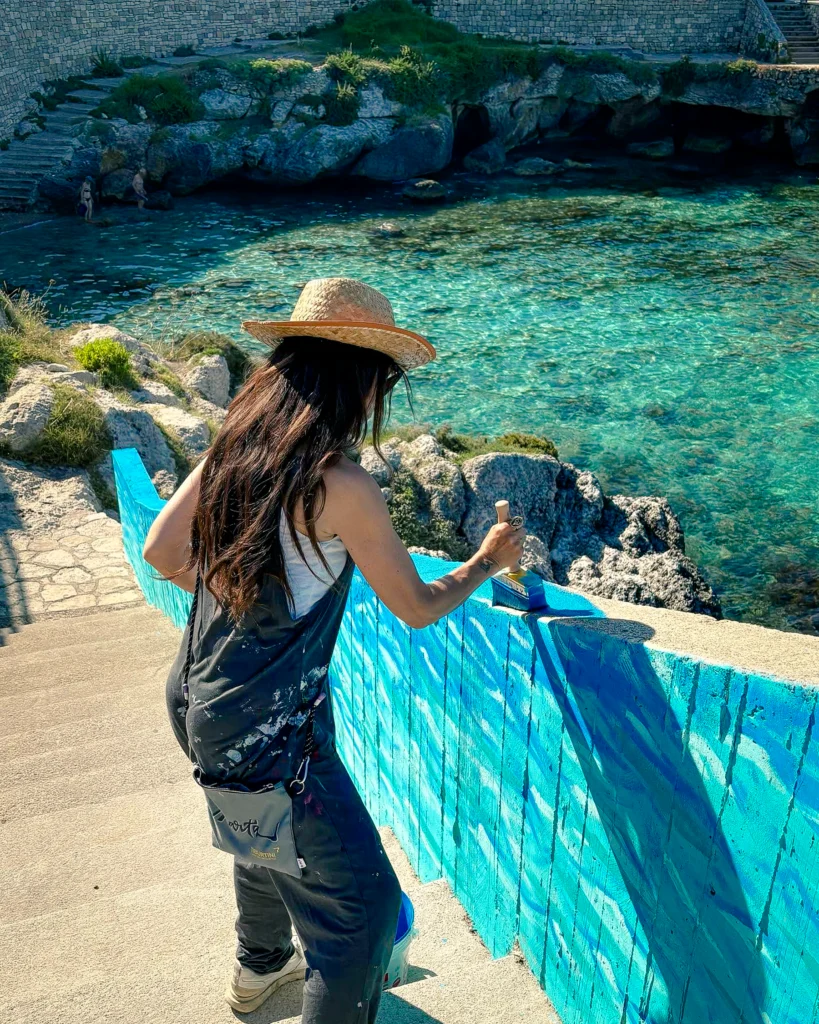
Pictorial intervention was created by Lisio Ferri using a palette of blues, turquoise and shades of azure.
Rather than depicting the sea literally, these colours evoke depth, movement and light, creating an almost impressionistic background from which the words emerge.
Colour follows the surface and changes its perception. Concrete balustrade loses its purely functional character and becomes part of a painted landscape that visually extends the natural one beyond it.
Palette also establishes an immediate connection with Santa Maria al Bagno: its water, Salento light and that particular Mediterranean condition in which the boundary between natural and built landscapes is constantly crossed by the eye.
Artwork does not attempt to compete with the sea. It enters into dialogue with it.
Calligraphy as a voice
Within this pictorial dimension, words take centre stage.
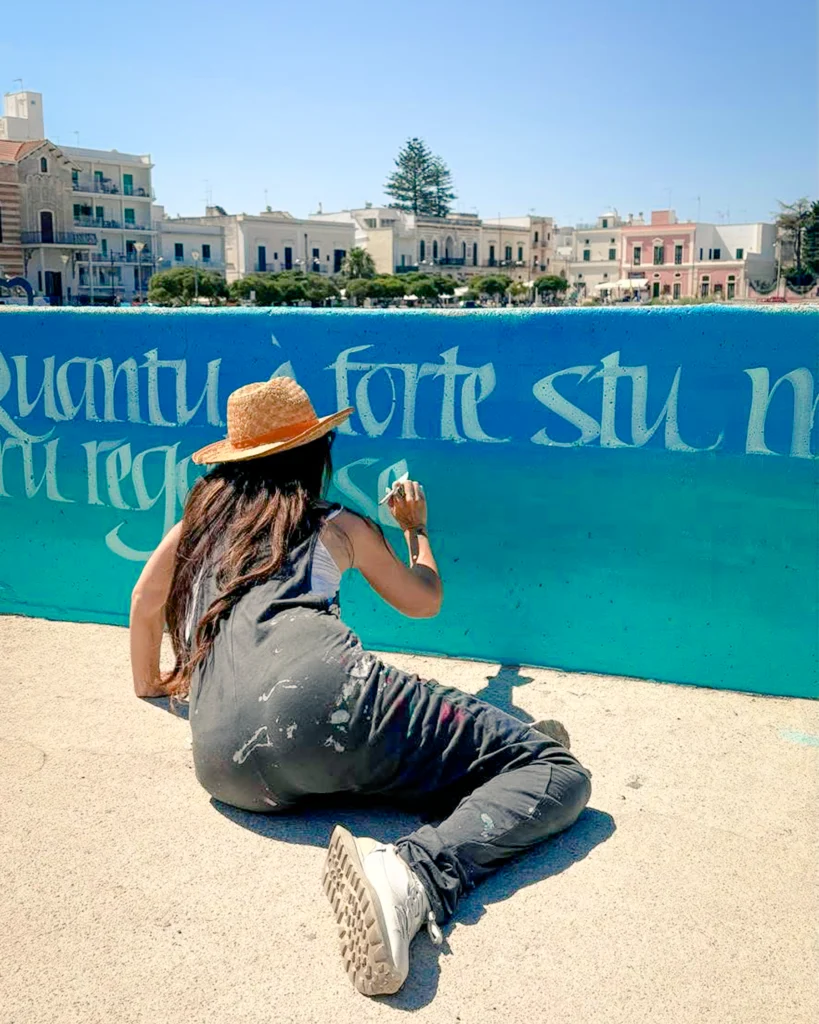
Diego’s line was composed by Marta Lagna through a calligraphic intervention conceived not as decorative writing, but as an integral part of the artwork.
Calligraphy brings the rhythm of the voice onto the surface. Letters become gesture, movement and material. The text, written in Salento dialect, retains its expressive force while acquiring a new visual dimension.
The choice of calligraphy is particularly significant because it allows the words to retain their human quality. This is not typography applied afterwards, but a mark created through the movement of the hand.
Within Marta Lagna’s practice, writing therefore becomes image.
It is a principle that runs throughout her work: words are considered not only for what they say, but also for what they can become when they enter a space. A phrase can turn into an architectural element, a surface, an artwork or an experience.
Here, calligraphy also carries an emotional dimension. Diego, who died at just 44 after a long illness, returns to speak through these words. No longer only through music, but through a permanent mark within public space.
Marta Lagna and Lisio Ferri: two languages, one artwork
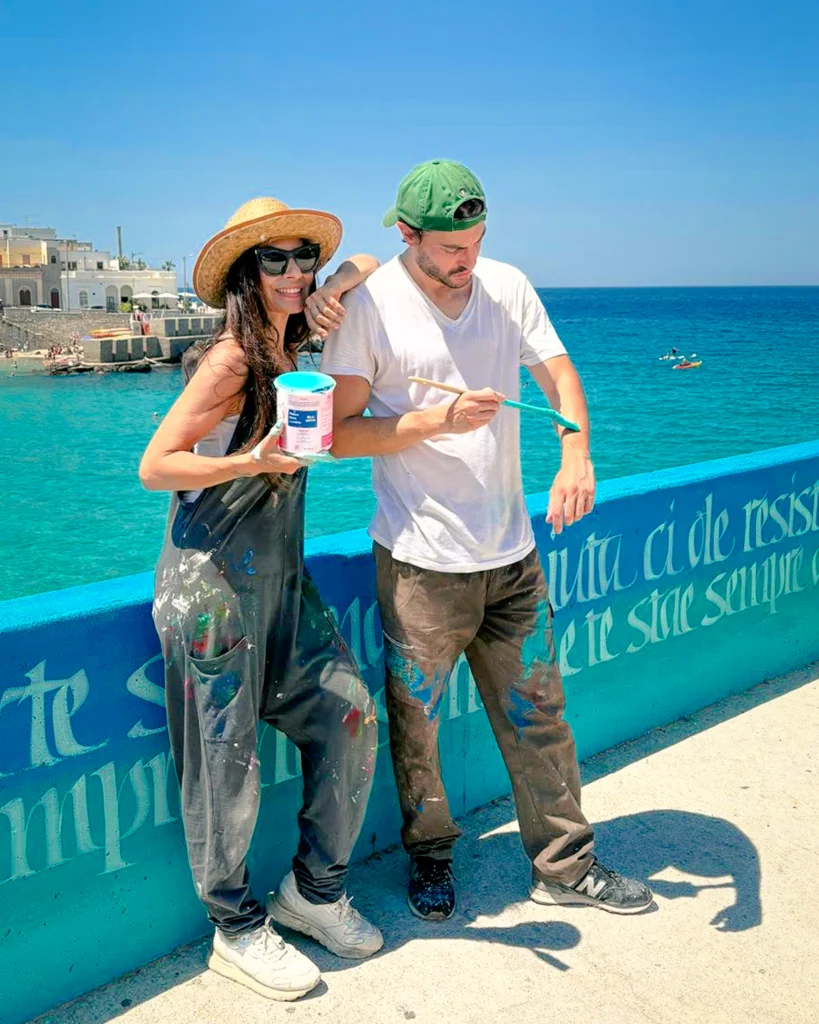
The project emerges from a dialogue between two different artistic sensibilities.
On one side, Lisio Ferri’s pictorial work, built through colour and a visual materiality that recalls the movement of water. On the other, Marta Lagna’s calligraphic research, centred on words and gesture.
Painting and writing are not treated as separate elements. They meet on the same surface to construct a single narrative.
The result is an artwork in which text is not a caption for the image, while the image is not simply a background for the text. Both contribute to the construction of meaning.
This dialogue is what makes the mural particularly consistent with Marta Lagna’s research: taking writing beyond the page, transforming it into a spatial element and placing it in dialogue with places, people and communities.
A tribute that belongs to the city
The mural was born from the memory of an artist, but it does not remain confined to private memory.
Diego Spano had a deep relationship with Nardò and its surrounding territory. His music portrayed Salento through a language, imagery and sensibility intimately connected to these places.
For this reason, choosing a line from Lu sule a Mile Beach carries particular meaning. The project does not simply commemorate a musician who is no longer here; it returns part of his voice to the city.
The artwork becomes a form of public memory, accessible to everyone. Those who knew Diego can recognise the words and reconnect with a personal memory; those who never met him can encounter part of his story through the mural.
This is where public art finds one of its most important functions: transforming individual memory into collective heritage.
From street art to street poetry
The project also explores the broader potential of urban art as a tool for transforming public space.
Here, street art meets poetry, music and calligraphy. The wall is no longer simply a surface to decorate, but becomes a narrative device capable of changing how a place is perceived.
The stairway, previously marked in part by vandalism, is returned to the community through an artwork that creates a renewed sense of belonging.
It demonstrates how art can become a form of urban design without losing its cultural dimension. On the contrary, it can make a place more recognisable, more inhabitable and more deeply connected to its identity.
The use of Diego’s words in Salento dialect reinforces this relationship. There is no need to translate the territory into a neutral or universal language: the local voice itself becomes the protagonist.
Salento is told through one of its most authentic forms of expression: its own voice.
An artwork between land and sea
Seen from the stairway, the mural takes on an additional meaning.
The writing stands literally in front of the sea. The words speak of the water, and the water is there, beyond the balustrade, real and present.
It is difficult to imagine a more direct setting for a line like this.
The project establishes a relationship between three elements: an artist’s memory, the creative gesture and the landscape.
The wall preserves the words. Colour creates a new perception of the surface. The sea completes the artwork.
The mural is therefore not an isolated object, but part of the place itself. It lives in the changing light, interacts with the movement of people and responds to the movement of the water. It was conceived to be crossed and experienced, not simply observed.
Writing as a form of permanence
In Marta Lagna’s work, calligraphy often becomes a way of giving permanence to words.
Here, permanence takes on an even stronger meaning. A song belongs to the time of listening. A mural belongs to the time of a place.
Diego’s words therefore move from music into matter, finding a new way to exist within public space. They continue to be voiced, in a sense, by those who read them, while becoming part of the landscape of Santa Maria al Bagno.
This transformation — from voice to mark, from song to wall, from individual memory to collective memory — lies at the heart of the project.
“Quantu è forte stu mare…” is not simply a line about the sea of Salento.
It is a sentence about resilience, belonging and presence.
A thought Diego left to his land, now returned to the city through art.
In Santa Maria al Bagno, his voice continues to stand beside the sea.
PROJECT SUMMARY
PROJECT
Santa Maria al Bagno Stairway Mural — Tribute to Diego Spano / Mr. Linfa
CLIENT / BRAND
Municipality of Nardò
INTERVENTO
Mural · Wall calligraphy · Street poetry · Pictorial intervention · Public space regeneration
YEAR
2025
LOCATION
Lungomare Emanuele Filiberto, Santa Maria al Bagno — Nardò (LECCE)
CONCEPT
A line from a song by Diego Spano becomes a permanent artwork overlooking the Salento sea, transforming a stairway leading to the cove into a space of memory, poetry and contemporary identity.